
Here is a question I get from clients at least twice a month: 'Should I use Differin or CeraVe Retinol?' Both are OTC. Both are under $25. Both are in the retinoid family, technically. So the confusion is completely understandable. But these two products are built for different problems, and picking the wrong one means spending weeks dealing with irritation, no results, or both.
The short answer: if you are dealing with active breakouts and your primary goal is stopping new acne, Differin Gel (adapalene 0.1%) is the more targeted tool. If your goal is fading post-acne marks, smoothing uneven texture, evening tone, and supporting your skin barrier year-round, especially if your skin is sensitive or you are new to retinoids, the CeraVe Resurfacing Retinol Serum is the better starting point for most women I work with. I will walk through exactly why below.
| Feature | CeraVe Retinol | Differin Gel |
|---|---|---|
| Active ingredient | Encapsulated retinol (vitamin A) | Adapalene 0.1% (synthetic retinoid) |
| Best for | PIH fading, texture, tone evening | Active acne, clogged pores, breakout prevention |
| Tolerance | Gentler, gradual release from encapsulation | Higher irritation potential, especially weeks 1 to 4 |
| Price | Around $18 to $19 (Amazon) | Around $13 to $15 (drugstore or Amazon) |
| Niacinamide pairing | Built-in niacinamide + licorice extract + ceramides | No niacinamide, you add it separately if desired |
| Sensitive skin friendly | Yes, formulated for sensitive skin | Use with caution, adapalene is stronger |
| Best fit | Year-round generalist for most skin types | Best for oily/acne-prone skin with active breakouts |
What Is Actually in Each Formula
Retinol and adapalene both belong to the retinoid family, but they work differently at the skin level. Retinol is vitamin A in its classic form. The body converts it to retinoic acid inside the skin cell, which is what actually does the work: accelerating cell turnover, supporting collagen production, and fading hyperpigmentation left behind by healed breakouts. The CeraVe version uses encapsulated retinol, meaning the retinol is wrapped in a lipid shell that releases slowly over hours. That single design choice makes it significantly more tolerable than straight retinol, especially for dry or sensitive skin.
Adapalene (the active in Differin) is a third-generation synthetic retinoid. It binds to specific retinoic acid receptors in the skin and regulates how pores produce sebum and shed dead skin cells, which is exactly why it is so effective at preventing the microcomedones that turn into blackheads and inflammatory pimples. It became OTC in 2016, which was a genuinely useful development for anyone dealing with recurring acne who did not want to visit a derm every few months for a prescription. But adapalene is still a more aggressive molecule than encapsulated retinol, and the adjustment period is real.
The CeraVe Resurfacing Retinol Serum adds a few supporting ingredients that matter: niacinamide for redness and pore appearance, licorice root extract for additional brightening, and ceramides (1, 3, and 6-II) to reinforce the skin barrier while the retinol is doing its job. That combination means the serum is doing four jobs at once, resurfacing, brightening, calming, and barrier support. Differin is a one-ingredient formula. Great at its job; just narrower in scope.

Where CeraVe Retinol Wins
The clearest advantage of the CeraVe Resurfacing Retinol Serum is breadth. Most of my clients are not dealing with cystic acne every week. They are dealing with the aftermath: brown marks that linger for months after a breakout heals, dull and uneven skin tone, fine surface texture, and a barrier that is already a little tired from years of cleansers and spot treatments. Encapsulated retinol addresses all of that without adding more stress to skin that already has some.
The tolerance profile is also meaningfully better. Most people can use this serum every other night from week one without experiencing the peeling and sensitivity spike that adapalene commonly causes during its adjustment period. That matters practically: you are more likely to stick with a product that does not make your face look like it is shedding. For skin types that run dry, are rosacea-adjacent, or tend to react to new actives, the CeraVe serum is the lower-risk starting point by a wide margin.
Long-term use is also more versatile. I have clients who have been on the CeraVe Retinol Serum for over a year and continue to see incremental improvements in skin clarity and tone. You can use it in summer, in winter, through hormonal fluctuations, on a travel trip where your skin is already stressed. The ceramide backbone of the formula helps buffer against the dryness that longer-term retinol use can cause in some people.
If your goal is fading marks and smoothing texture, this is where I would start.
The CeraVe Resurfacing Retinol Serum combines encapsulated retinol with niacinamide, licorice, and ceramides, four active goals in one gentle nightly formula. Over 55,000 Amazon reviews back it up.
Amazon Check Today's Price on Amazon →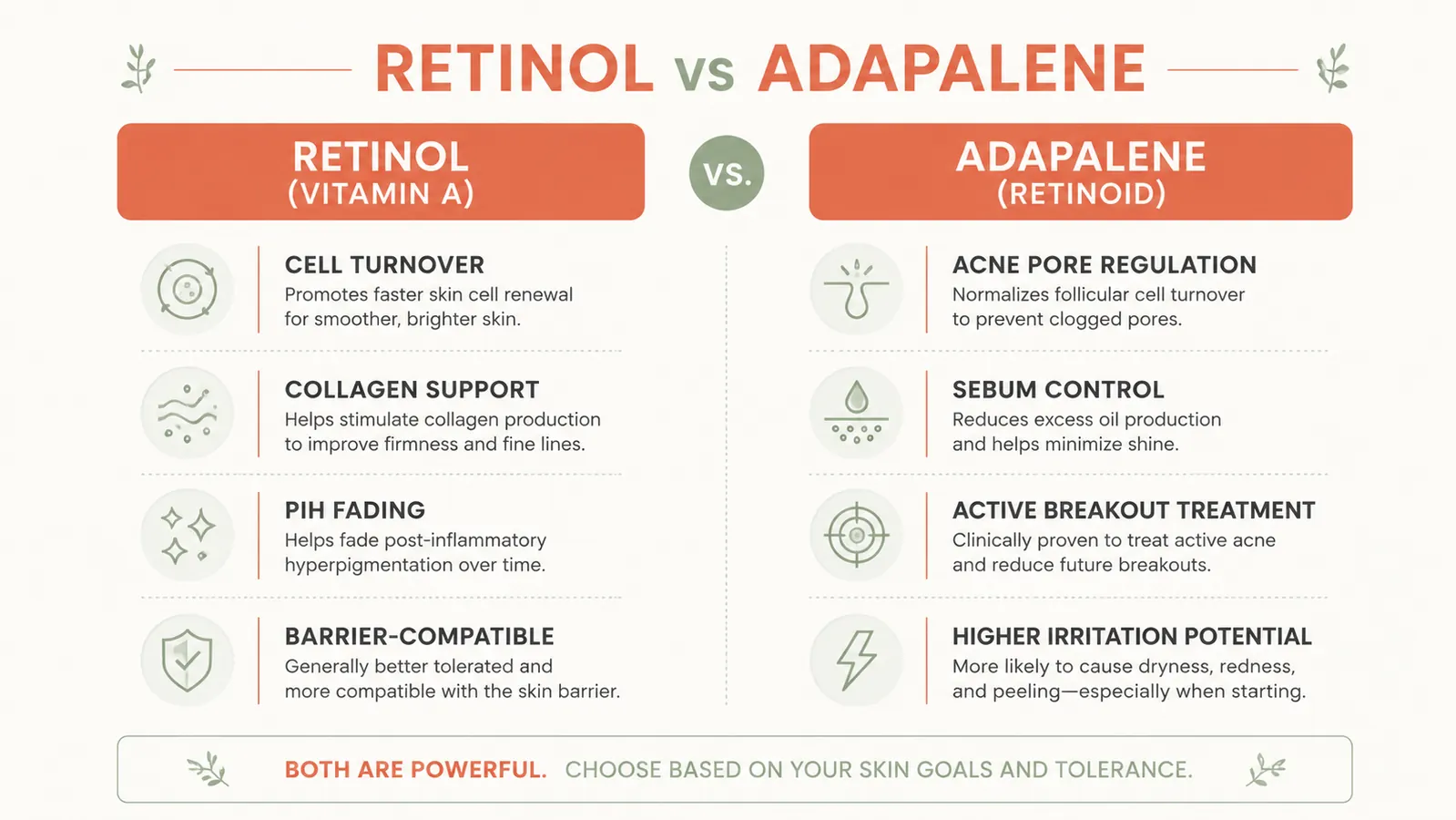
Where Differin Gel Wins
Differin earns its reputation in one scenario: consistent, moderate-to-severe comedonal and inflammatory acne. If you are getting new pimples every week, if you have a persistent problem with blackheads across your nose and chin, or if topical benzoyl peroxide and salicylic acid have not moved the needle, adapalene has a mechanism that addresses the root cause more directly than retinol does. It regulates the abnormal desquamation inside the pore, meaning it helps prevent the blockage before it forms, not just fade the mark after it heals.
The price is also slightly lower than the CeraVe serum, and if you have oily skin that handles active molecules well, the adjustment period is manageable with a good moisturizer and some patience. Dermatologists have been recommending adapalene for acne for decades, the OTC version is the same active ingredient at the same concentration as many prescriptions that were written throughout the 1990s and 2000s. For the right person with the right problem, it is a solid tool.
Adapalene is a targeted acne treatment. Retinol is a general skin-quality tool. Confusing the two is how people end up frustrated that their 'acne product' is not fading their marks, or that their 'retinol' is not clearing their breakouts.
But it is worth being honest about where Differin struggles for the women I work with. Many of my clients are 28 to 45, dealing with skin that is simultaneously post-acne and showing early signs of uneven tone and texture. Differin does not directly address hyperpigmentation. It does not support the skin barrier. And for anyone who runs dry, combination-dry, or sensitive, the purge period can be discouraging enough that they stop using it before it has a chance to work. Retinol, by contrast, tends to show early wins in radiance and smoothness within four to six weeks, which makes it easier to stay consistent.

Who Should Buy Which
Start with CeraVe Resurfacing Retinol Serum if you fit any of these: you are new to retinoids and want to introduce one carefully; your main concerns are PIH (post-inflammatory hyperpigmentation), dull tone, and texture rather than active daily breakouts; your skin runs dry, sensitive, or combination; you want one product that does multiple things without buying a separate niacinamide serum; or you are looking for a year-round formula you can use through all seasons without dialing back.
Consider Differin Gel instead if you are in your 20s with oily, resilient skin and you are breaking out consistently right now, not dealing with marks from old breakouts, but new pimples forming every week. It is a legitimate prescription-strength active that became OTC, and for true comedonal acne it is often more effective than anything else in the drugstore price range. Just pair it with a ceramide moisturizer from the start, keep it to every other night for the first month, and accept that weeks three and four may look worse before they look better.
If you are dealing with both active acne and post-acne marks, talk to a dermatologist about using both strategically, alternating nights or using adapalene on certain zones and retinol on others. Self-managing two actives simultaneously without guidance can compromise your barrier faster than either one would alone.
Ready to start with the gentler, multi-tasking option?
CeraVe Resurfacing Retinol Serum is a consistent top pick for women who want real retinoid results without the adaptation struggle. Encapsulated retinol plus ceramides, niacinamide, and licorice root, all in one drugstore-priced bottle.
Amazon Check Today's Price on Amazon →