
I've seen more vitamin C serums go to waste because of bad layering than for any other reason. A client will spend $35 on a well-formulated bottle, use it for six weeks, wonder why her skin looks exactly the same, and eventually toss it. Nine times out of ten, the problem isn't the serum, it's the order, the timing, or the ingredient sitting right next to it in her routine that's cancelling it out. Vitamin C is a high-maintenance active. It requires the right pH environment, specific placement in your routine, and careful storage. Get those three things right and it works hard for you. Get them wrong and you're moisturizing with a bottle of expensive orange water.
This guide covers the full morning routine sequence step by step, the wait times that actually matter, the ingredient combinations that cause problems, and the storage mistakes that kill efficacy before you even open the cap. I recommend TruSkin Vitamin C Serum throughout because it's what I use personally and what I've recommended to clients for several years, but the layering rules apply to any L-ascorbic acid formula you choose.
If your vitamin C serum isn't brightening anything, the layering order might be the issue.
TruSkin Vitamin C Serum has 155,000+ Amazon reviews and a 4.4-star rating. It contains 20% vitamin C, hyaluronic acid, and vitamin E in a stable, pump-free dropper format. Check whether it's currently in stock before reading further, it sells out periodically.
Amazon Check Today's Price on Amazon →Why Layering Order Matters More Than the Serum Itself
Vitamin C (specifically L-ascorbic acid) is water-soluble and most effective at a pH between 2.5 and 3.5. Your skin's surface is naturally acidic, sitting around pH 4.5 to 5.5. When you apply vitamin C to clean skin immediately after cleansing, before anything else buffers that pH up, you're giving it the most hospitable environment it's going to find all morning. Apply it after a moisturizer or after SPF and you've raised the surface pH enough that a meaningful portion of the active can't penetrate at the rate it was designed to.
There's a second reason order matters: molecular weight. A general rule in skincare is to layer thinnest to thickest. Vitamin C serums are typically watery-to-gel in consistency, which means they need to go on before creams and oils that would physically block them. If you apply a facial oil before your vitamin C serum, you've put a hydrophobic barrier between the serum and your skin. The serum sits on top of the oil. It may feel like it's absorbing but the penetration is compromised.

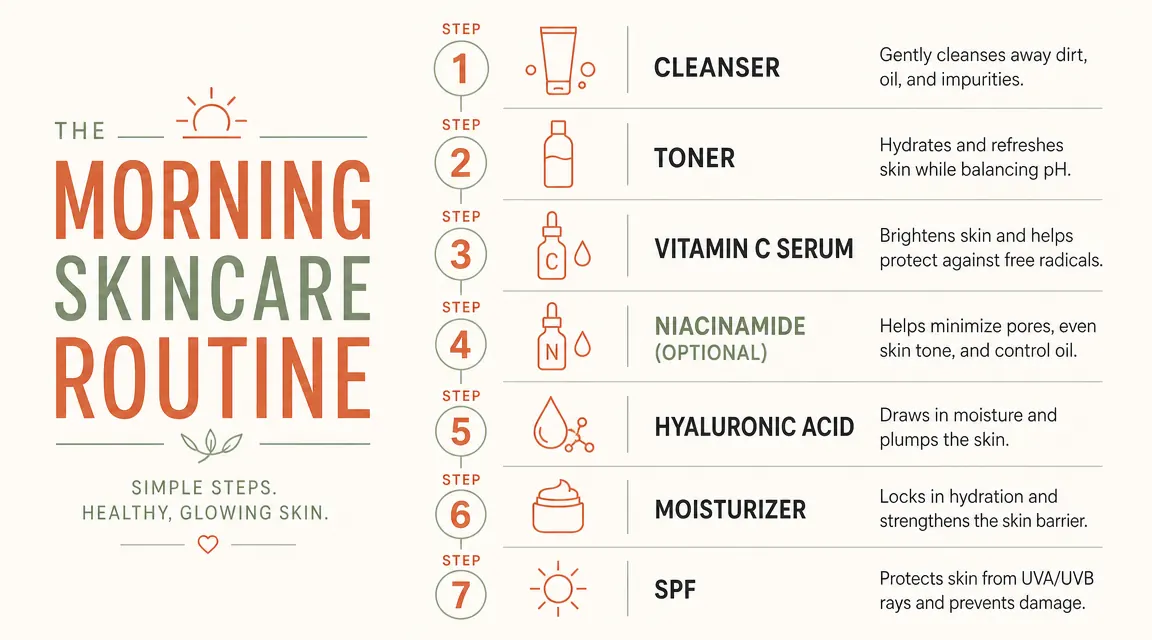
The Full Morning Routine, Step by Step
Step 1: Cleanse Thoroughly
Use a gentle, low-pH cleanser, nothing with sulfates that strip the acid mantle hard. You want clean skin without over-stripping. An over-stripped barrier has a compromised surface pH, which can actually cause mild stinging when you apply vitamin C. If TruSkin's serum has ever stung or tingled on your cheeks, check your cleanser first. Rinse with lukewarm water and pat dry. Do not rub with a towel. You want the skin just barely damp, not soaking wet.
A note on cleansing in the morning: some people skip a full cleanse and just rinse with water at night and follow with a proper cleanser. Either approach works. What matters is that your face is free of overnight skincare residue before you apply vitamin C. Sleeping in moisturizer and then layering vitamin C on top in the morning is one of the quieter ways to reduce efficacy.
Step 2: Apply Toner (If You Use One)
Toner is optional, but if you use one, it goes before your vitamin C. The key here is pH. If your toner is exfoliating, meaning it contains AHA (glycolic, lactic acid) or BHA (salicylic acid), apply it, wait two minutes for your skin to normalize, then apply the vitamin C. Exfoliating toners temporarily lower surface pH, which sounds helpful for an acid-dependent active like vitamin C, but using them back-to-back with a high-concentration vitamin C formula increases irritation risk substantially. Space them or keep them in separate routines.
If your toner is hydrating, just water, hyaluronic acid, aloe, niacinamide, it can go before your vitamin C without a wait period. Lightweight hydrating toners don't significantly affect surface pH and don't compete with vitamin C's mechanism. Apply it, let it settle for thirty seconds so it's not dripping, and move to the serum.
Step 3: Apply Your Vitamin C Serum
Dispense three to four drops of TruSkin Vitamin C Serum onto your fingertips. Press it into your skin rather than rubbing, patting motions give the actives better contact with your face than dragging a thin layer across it. Work from the center of your face outward. Cover your forehead, cheeks, nose, and chin. If your neck and chest are a priority, extend down. The skin on your neck is thinner, so if it's your first time using a vitamin C with any kind of concentration, skip the neck for the first two weeks and introduce it gradually.
Once applied, wait at least sixty seconds before moving on. Some estheticians recommend waiting a full minute to two minutes for vitamin C to begin absorbing before layering on top of it. I tell my clients to do two minutes if they have the time and their serum has a watery texture. TruSkin's formula is slightly gel-adjacent and absorbs a bit faster, so sixty to ninety seconds is usually enough. You'll feel it go from wet to tacky to a dry-ish finish. That's your signal.
Vitamin C needs to meet clean skin at the right pH. Every layer you add before it raises the surface pH and reduces how much the active can do. That's the whole story.
Step 4: Niacinamide, Know the Real Rule
You've probably heard that you can't use niacinamide with vitamin C. The concern goes back to decades-old research suggesting the two react to form niacin, a compound that can cause flushing. In practical terms, this reaction requires very high temperatures and specific conditions that don't exist on a bathroom counter. Modern formulations buffer this, and the amounts of niacin that would form during normal use are too small to cause a visible reaction in the vast majority of people.
That said, the combination can reduce the effectiveness of both actives when applied on top of each other immediately. My recommendation is simple: apply your vitamin C serum first, wait two minutes, then apply your niacinamide-containing product. Don't mix them in your palm. Don't layer them wet on wet. The brief wait time is enough to let the vitamin C absorb into skin before niacinamide arrives, so each active gets adequate contact without competing at the surface. If you want the cleanest possible result, move your niacinamide to your evening routine entirely. But the same-routine approach with a wait time is fine for most people.
Step 5: Hyaluronic Acid
Hyaluronic acid is the most uncomplicated step in this sequence. It plays well with everything. Apply it after your vitamin C has settled, and it draws moisture into the outer skin layers, which helps your skin feel comfortable and supple under everything that follows. TruSkin's Vitamin C Serum already contains hyaluronic acid in the formula, which is one reason the texture isn't as dry as some high-concentration vitamin C serums. If you want extra hydration, especially if you're in a dry climate or a dry office, add a separate hyaluronic acid serum or a few drops of HA booster before your moisturizer.
One tip that gets overlooked: apply hyaluronic acid to slightly damp skin if you can. HA binds to water, and if you apply it to completely dry skin in a dry room, it pulls moisture from the deeper layers of the skin toward the surface rather than from the air. Slightly damp skin gives it water to bind to immediately. Not soaking wet, just the residual dampness from patting dry, or a very light mist of water on your face.
Step 6: Moisturizer
Your moisturizer seals everything in. Apply it while your skin still has a slight tackiness from the previous steps, this helps the moisturizer bond with the layers underneath rather than sitting on top as a separate film. Look for a moisturizer that doesn't contain a lot of heavy silicones if you're going under makeup. Silicone-heavy creams can pill when other products layer on top. For reference, La Roche-Posay Toleriane Double Repair is a lightweight ceramide moisturizer that works well in this sequence without pilling or disrupting the vitamin C layers underneath it.
This step is also where retinol does not belong, to state the obvious. If you're using a retinol or retinoid, it goes in your evening routine only. Vitamin C is your morning antioxidant. Retinol degrades in UV light, cancels some of the antioxidant work vitamin C is doing, and pairs with sun exposure in ways that increase photosensitivity. Keep them on separate shifts. Mornings are for vitamin C. Evenings are for retinoids.
Step 7: SPF, Last In, Every Morning
SPF is the last step, always. It goes on after moisturizer, never under it. The reason is physical: sunscreen works by sitting on top of skin and either absorbing or reflecting UV rays. If you put moisturizer on top of your sunscreen, you dilute its concentration at the surface and reduce its effectiveness. Apply a nickel-sized amount of SPF 30 or higher across your face and neck, let it sit for sixty seconds before you touch your face or apply makeup, and don't skip the ears or hairline.
Vitamin C and SPF are genuinely complementary here, not just co-existing. Vitamin C is an antioxidant that neutralizes free radicals generated by UV exposure. SPF blocks the UV rays in the first place. Using them together gives you more protection than either one alone. This is one of the few actual synergies in skincare that is well-supported by research rather than marketing copy. If you've been skipping vitamin C or skipping SPF but using the other one, pairing them is one of the higher-leverage changes you can make to your morning routine.
The Mistakes That Kill Vitamin C Before It Has a Chance
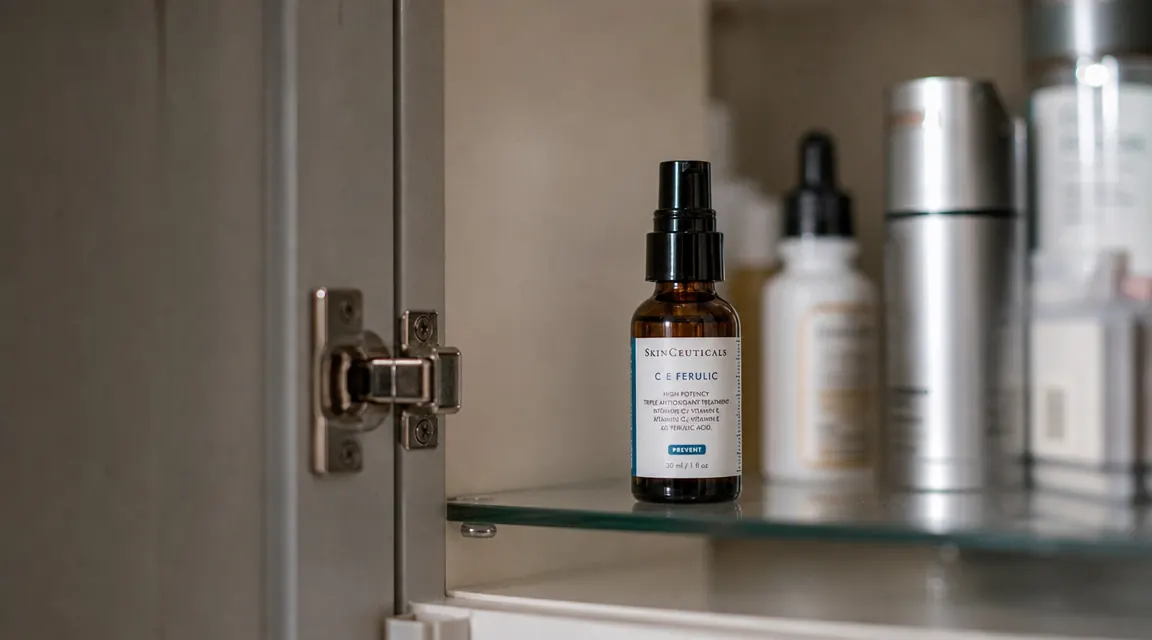
The most common mistake I see is storing a vitamin C serum on a bathroom windowsill or shelf where it gets daily exposure to light and heat. Vitamin C oxidizes when exposed to air, light, and heat. An oxidized serum turns from clear or pale yellow to orange or brown and becomes largely ineffective. It may also irritate skin more than fresh product. The fix is to store your vitamin C serum in a cabinet or drawer away from your bathroom's steam and light, cap it tightly after every use, and buy in a size you'll go through within three to four months of opening.
The second common mistake is applying vitamin C over an occlusive or facial oil. If you use a facial oil anywhere in your morning routine, it belongs either before your moisturizer as a serum step or after moisturizer as the last step before SPF (though over SPF is a separate debate). It does not belong before vitamin C, period. Oils create a hydrophobic film that water-soluble actives can't penetrate well.
The third mistake is using vitamin C at night. Vitamin C is an antioxidant targeted at daytime oxidative stress from UV, pollution, and environmental exposure. Your skin repairs itself at night via different mechanisms that don't require antioxidant support to the same degree. More practically, some people find that vitamin C applied at night causes their skin to feel warmer or redder if they're slightly reactive. Morning is when you need it and when it works best. Save it for your AM routine.
What Else Helps
Consistency beats everything. Vitamin C works cumulatively, the brightening, collagen support, and antioxidant effects accumulate over weeks. A client who applies it every morning for eight weeks will see considerably more change than a client who applies it three or four days a week for the same period. If your current routine makes it hard to use vitamin C every day, simplify everything else rather than dropping the vitamin C. A basic routine you do every day outperforms a perfect routine you do three days a week.
If you're new to vitamin C or have reactive skin, start with every other morning for the first two weeks. Your skin may need a brief adjustment period. After two weeks, move to daily use. Most people experience no adjustment period at all, but if your skin tends to be temperamental with new actives, this ramp-up approach removes the risk of early irritation that causes people to abandon a serum they would have done well with after a proper introduction.
For a deeper look at TruSkin Vitamin C Serum specifically, what it actually does to skin over four months, the oxidation timeline, and whether the formula holds up in humid climates, read the full long-term review. And if you're building out the rest of your morning routine, the guide to wearing sunscreen every day covers SPF selection and reapplication in far more detail than a single step in this article can.
Ready to build the habit? Start with a serum that's been tested by 155,000 people.
TruSkin Vitamin C Serum is $34.99 and contains 20% vitamin C, vitamin E, hyaluronic acid, and botanical botanicals in a stable formula. It's well-suited for this layering sequence because the texture is lightweight enough to go under toner, niacinamide, HA, moisturizer, and SPF without pilling or creating a sticky base. Check current availability before you leave.
Amazon Check Today's Price on Amazon →