
I want to tell you something before you order TruSkin Vitamin C Serum based on its 155,000-plus Amazon reviews. Those reviews are not wrong, but they are not telling you the full story either. I spent six weeks testing this serum on my combination skin in Brooklyn, and I have opinions that did not fit neatly into a five-star rating. Some of what I found surprised me. Some of it explains exactly why a small percentage of people return it immediately. And all of it is worth knowing before you hand over your credit card.
This is not the long-term results article. If you want the before-and-after breakdown after four months of consistent use, that is over in the TruSkin Vitamin C Serum long-term review. What I am doing here is different. I am talking about everything the product page leaves out: the texture that catches people off guard, the smell, the way this formula behaves differently than the luxury serums it is often compared to, and the skin types that should probably look elsewhere.
The Quick Verdict
A genuinely solid drugstore-tier vitamin C serum that over-delivers on results for the price, but the thick gel texture, faint scent, and slower-than-advertised timeline mean it is not the right fit for everyone.
Amazon Check Today's Price →Already decided? Check current pricing before the rate changes.
TruSkin Vitamin C Serum is a best-seller with frequent price fluctuations. Click through to see today's price and check availability before you keep reading.
Amazon Check Today's Price on Amazon →How I Tested This (And Why I Kept Notes)
I am a licensed esthetician. I have been in treatment rooms long enough to know that skincare marketing and skincare reality are two different zip codes. When I review a product, I document it the way I would if a client were asking me whether to add it to their routine. That means notes on first application feel, changes at the two-week mark, any skin reactions, and how the formula performs across different skin types in my network.
For this review, I applied TruSkin Vitamin C Serum every morning on clean, slightly damp skin for six full weeks. No skipped days, no mixing with other actives until week three. I also had three friends test it alongside me: one with dry skin prone to flaking, one with oily skin and recent hormonal breakouts, and one with sensitive rosacea-prone skin. What each of us experienced was meaningfully different.
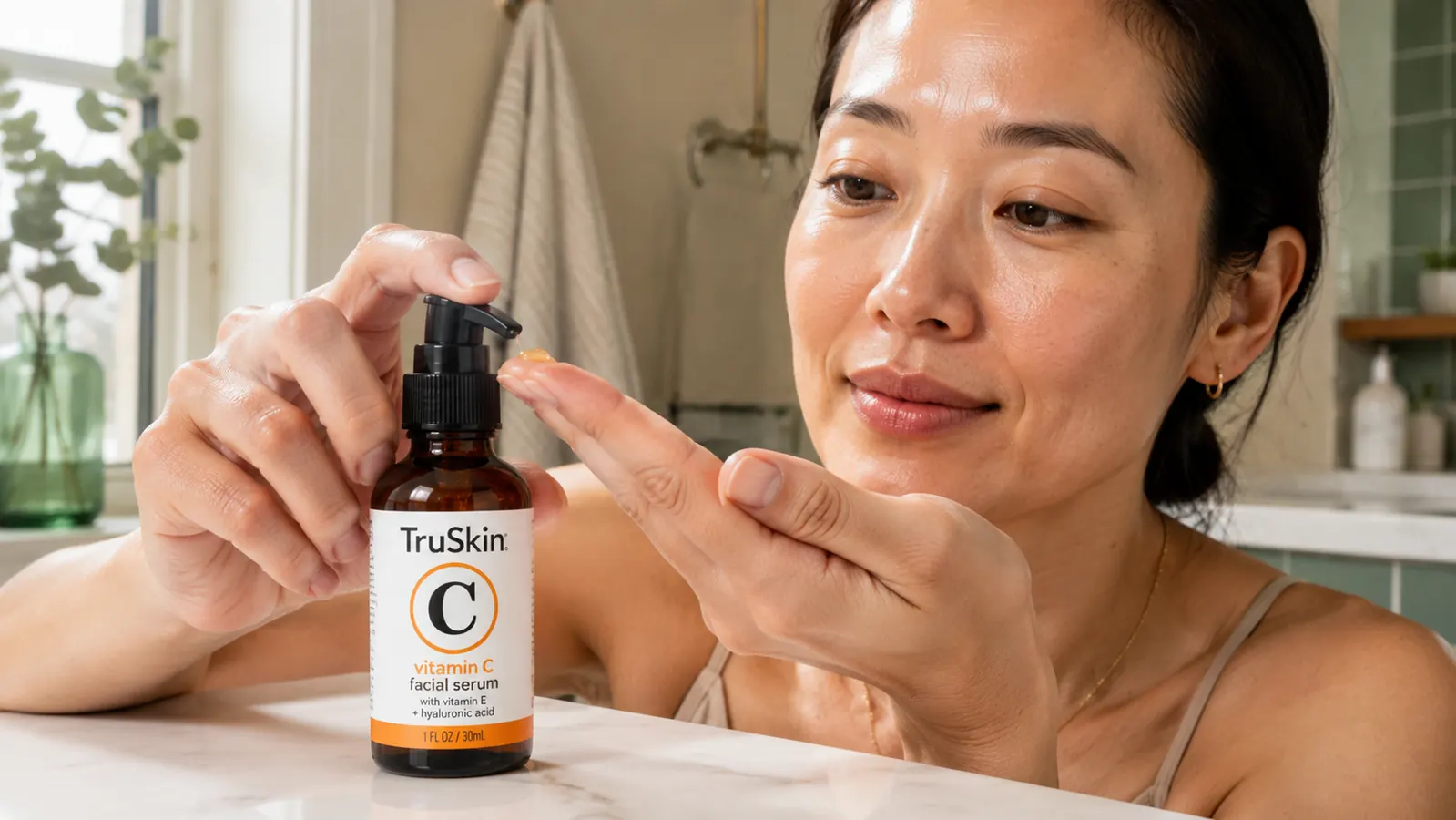
The bottle I started with was fresh, with the formula sitting at a light amber-yellow. By week four, it had shifted to a deeper golden tone, which I will explain in the oxidation section below. The pump dispenser worked reliably throughout and I appreciated that it was not the typical open-top bottle that exposes the product to air every single use.
The Texture Problem Nobody Warns You About
When most people picture a vitamin C serum, they imagine something thin and watery. L-ascorbic acid serums from high-end brands like SkinCeuticals C E Ferulic or Paula's Choice C15 are watery with barely-there slip. TruSkin is not that. TruSkin Vitamin C Serum has a gel-serum texture that sits somewhere between a lightweight gel moisturizer and a traditional water-based serum. It has body. You feel it on your skin.
For most skin types, this is not a problem. It absorbs within about 60 to 90 seconds, leaves no sticky residue, and layers well under a moisturizer and SPF. But if you have oily or acne-prone skin and you are already juggling a full routine, that extra weight on step two can feel like one too many layers, especially in humid summer months. My friend Jonelle, who has very oily skin and runs warm, said it made her feel greasy within an hour on the days she used it before a heavier moisturizer. She had better results applying it alone as a thin layer before a lightweight moisturizer with no occlusive ingredients.
The texture also means it does not absorb uniformly on every face. On drier skin, my friend Claudette with her flaky T-zone loved it because the gel body gave some slip and felt moisturizing. On rosacea-prone skin, my friend Petra had to test application pressure carefully. Too much rubbing during application caused flushing, which is a texture issue more than a formula issue.
If you have used a water-thin vitamin C serum before and loved it, TruSkin will feel different. Not worse, but different. Give it a few days to adjust before you decide.
The Smell: Honest Report
Here is what the product page does not say: TruSkin Vitamin C Serum has a faint smell. Not offensive. Not strong. But it is there. On fresh application, it smells lightly citrus-adjacent with a faint note that some people describe as slightly sour or metallic. This is completely normal for vitamin C formulas containing ascorbic acid, because the acid oxidizes when it hits air and skin.
The smell fades within a minute or two of application. If you are scent-sensitive but not scent-allergic, you will probably barely notice it once you are used to it. However, if you have a strong aversion to any chemical-adjacent scent, this could bother you. I have seen one-star reviews that are entirely about the smell, which I find a bit harsh given that the scent does not linger. But it is a real thing, and you deserve to know it is there.
The formula contains no added fragrance, which I respect. The scent you are detecting is the active ingredient doing what active ingredients do, not a masking fragrance someone added to make the formula smell like a spa product. Unscented does not always mean odorless with vitamin C, and TruSkin is a good example of that distinction.
Oxidation: What It Means and When to Worry
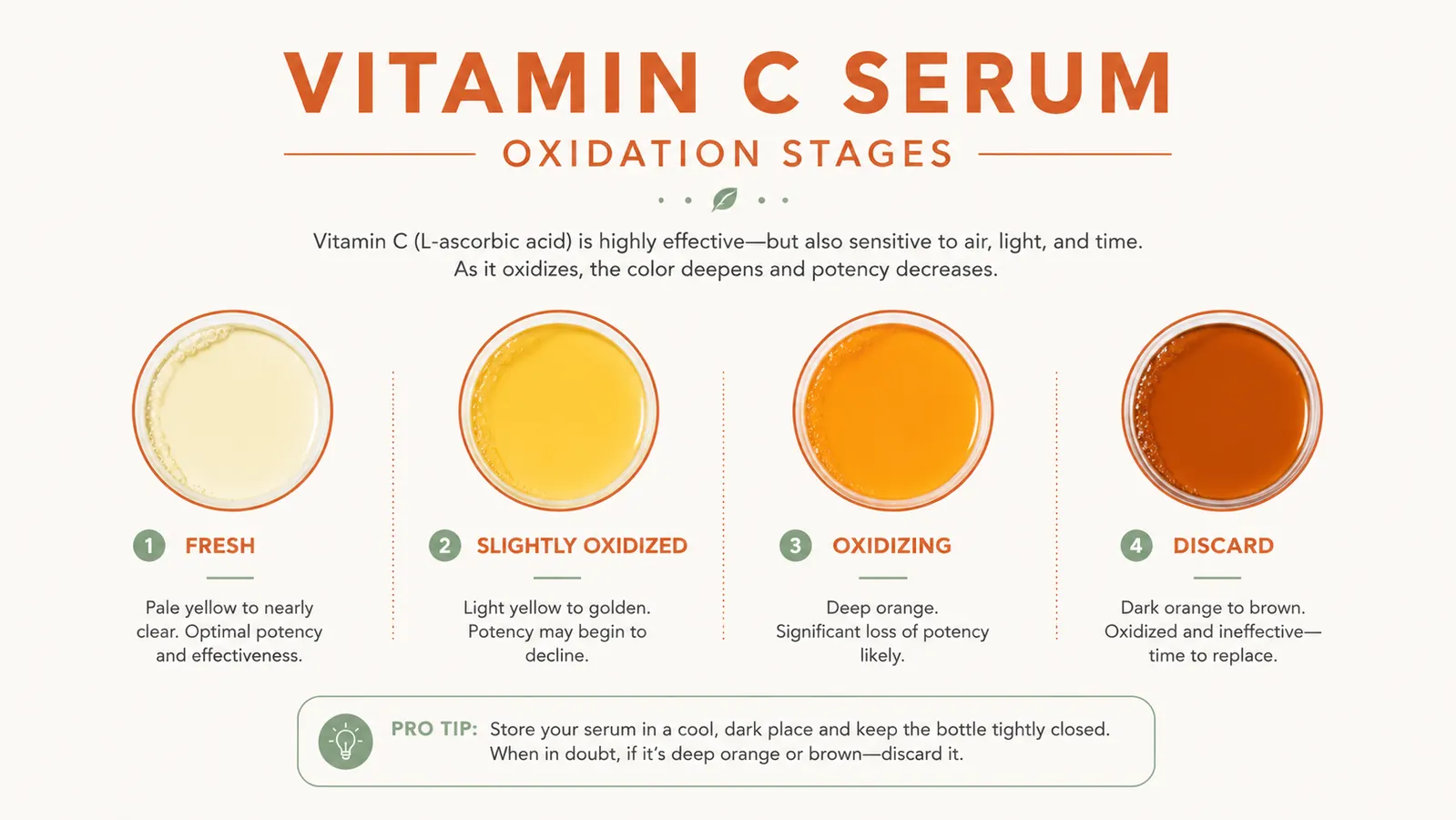
Vitamin C in the form of L-ascorbic acid is inherently unstable. It oxidizes when exposed to light, air, and heat, and as it oxidizes, it changes color and loses potency. A fresh TruSkin serum is a light pale yellow. As the bottle ages through normal use, it shifts to golden, then amber, then a deeper orange. When it turns brown or rust-colored, the vitamin C has largely deactivated and you are essentially applying a nice moisturizing serum with very little active antioxidant effect.
TruSkin is packaged in a dark amber glass bottle with a pump to minimize air exposure, which is better than many comparable serums. But the formula is still susceptible to heat and prolonged storage. I noticed a visible color shift between week two and week four of my bottle. That is not alarming for a larger bottle used consistently, but if you travel, keep it in your checked bag in hot weather, or store it near a sun-facing window, you will burn through the active ingredient faster than the bottle runs out.
The practical upshot: store this in a cool, dark spot like a cabinet or drawer, not on your counter in front of a window. Refrigerating it slows oxidation further. I keep mine in my bathroom cabinet behind the door. If your bottle turns deep orange before you are halfway through it, that is a storage problem, not a bad batch.
Who This Serum Is Not For
The most valuable part of any honest review is when a reviewer tells you not to buy something. So here is my clear-eyed list of skin types and situations where TruSkin Vitamin C Serum is probably not your best move.
Very sensitive or reactive skin that flushes easily: the ascorbic acid concentration in this formula is reported to be around 15 to 20 percent based on the formula feel and pH, which is on the higher end of drugstore vitamin C. For skin that reacts to anything over 10 percent, that can mean redness, tingling, and an uncomfortable adjustment period. If you have rosacea, active eczema, or a recently compromised barrier, I would start with a more stabilized vitamin C derivative like ascorbyl glucoside or magnesium ascorbyl phosphate, which are gentler and less likely to cause a reaction. Petra, my rosacea-prone tester, had to stop use after week two due to persistent facial flushing.
People who want fast results: TruSkin will not transform your skin in a week. Or two weeks. In my experience, meaningful brightening takes five to eight weeks of daily consistent use. The Amazon listing shows before-and-after photos that could be interpreted as faster results, but the fine print on those images almost always references 90-day use. If you need visible skin-tone change by next month for a specific event, this serum will disappoint. Plan for a full eight-week cycle before judging it.
People who have tried higher-end vitamin C serums and loved them: this is a meaningful consideration. If you have been using SkinCeuticals C E Ferulic at $182 a bottle and you are trying to find a budget substitute, TruSkin is not a one-to-one replacement. The CE Ferulic formula uses a synergistic blend of 15 percent L-ascorbic acid with ferulic acid and vitamin E at a pH specifically calibrated for maximum penetration. TruSkin has L-ascorbic acid, vitamin E, and hyaluronic acid but the formulation stability and the delivery system are not equivalent. You will likely see less dramatic results. That is not a knock on TruSkin as a value product. It is just an honest comparison.
What I Liked
- Strong antioxidant results for the price point, especially for first-time vitamin C users
- Pump bottle minimizes oxidation compared to open-cap or dropper alternatives
- Hyaluronic acid in the formula adds light hydration alongside the vitamin C
- Works very well for dry and normal skin types that handle actives without irritation
- Over 155,000 reviews provide a broad baseline for real-world outcomes across diverse skin types
Where It Falls Short
- Gel-serum texture is noticeably heavier than water-thin luxury vitamin C formulas
- Faint sour-citrus scent on application is off-putting to some users, especially scent-sensitive skin
- Not formulated for sensitive or rosacea-prone skin given the active acid concentration
- Oxidizes faster than claimed shelf life if stored near light, heat, or humidity
- Brightening timeline is slow: expect five to eight weeks minimum for visible results, not the two weeks implied in some marketing
How It Compares to Higher-End Alternatives
Let me be direct about the price-to-performance math. TruSkin at its current price is roughly one-fifth the cost of SkinCeuticals C E Ferulic and about half the price of the Paula's Choice C15 Super Booster. Is it half as good? No. But is it equivalent? Also no.
What TruSkin does well at its price point: it delivers consistent daily antioxidant protection, adds measurable glow over time, and supports an overall brighter skin tone. For someone who has never used a vitamin C serum, this is a very reasonable entry point. The formula is stable enough to use daily without dramatic instability issues if stored correctly.
Where higher-end formulas pull ahead: ferulic acid. Neither TruSkin nor most drugstore competitors include ferulic acid, which research suggests significantly amplifies the stability and efficacy of vitamin C and vitamin E together. If you want clinical-grade results for hyperpigmentation, melasma, or post-sun recovery, the ferulic acid formulas are meaningfully more effective. You are paying for that efficacy, and it is real. The comparison article looking at TruSkin against Mad Hippie gets into the weeds on this if you want an even closer comparison within the mid-range tier.

The Irritation Reports: Context Matters
If you scroll the one and two-star reviews on TruSkin's Amazon listing, you will find irritation reports. Stinging, redness, breakouts, itching. These are real experiences and I am not going to dismiss them. But I want to give you context so you can figure out whether your skin is likely to be one of the ones that has a reaction.
Most vitamin C irritation happens for one of three reasons. First, the skin barrier is already compromised or sensitized when the serum is introduced, often from recent over-exfoliation or harsh cleansers. Second, the person applied too much product. One to two pumps is all you need; four pumps saturating the skin is going to create acid overload. Third, they applied it immediately after other actives (retinol, chemical exfoliants, AHAs) without allowing adequate time for pH recovery. Vitamin C at a low pH stacked on top of AHAs at a low pH is a recipe for irritation on most skin types.
If you have very dry or compromised skin and you want to try this, I recommend starting every other day for the first two weeks, applying a thin layer, and following with a good moisturizer to buffer. That intro protocol prevents almost all the irritation issues I have seen clients report with mid-range vitamin C serums including this one.
Who This Is For
Despite everything I have just walked you through, I do recommend TruSkin Vitamin C Serum for a specific type of buyer. If you are new to vitamin C serums and want to find out whether your skin responds positively to this ingredient class before spending $90 or more, TruSkin is a smart and low-risk entry point. You will learn how your skin handles daily vitamin C, how to layer it in your routine, and whether brightening and antioxidant effects are noticeable on your face. That is valuable education at a very reasonable cost.
It also works well for normal-to-dry skin that tolerates actives without reactive tendencies, for people who are already consistent with their routine and want to add one brightening step, and for anyone who wants a serum they can keep replenishing without feeling like they are burning a hole in their budget every time the bottle runs out. Consistency is the actual driver of vitamin C results, and a serum that is affordable enough to re-buy consistently will out-perform a more expensive formula that you use sparingly to make the bottle last.
Who Should Skip It
Skip TruSkin if your skin is currently sensitized, inflamed, or showing signs of a compromised barrier like visible redness, tightness after washing, or flaking that is not dryness. Introducing a higher-concentration vitamin C onto damaged skin is how irritation reports happen. Fix the barrier first with a ceramide-based moisturizer and gentle cleansing, then revisit the serum when your skin is in a neutral, calm state.
Also skip it if you are already deep in an active skincare routine with multiple acids and retinoids and you are looking for something to push your results further. At that point you have outgrown the drugstore tier. You will see more by adding ferulic acid to your vitamin C stack through a clinical-grade formula, or by switching to a higher-stability vitamin C derivative that works at a less acidic pH and causes fewer stacking conflicts.
If TruSkin sounds like a fit for your skin, today's price is worth locking in.
This one moves in and out of discount pricing. Check the current price on Amazon and read through recent reviews filtered by your skin type before buying.
Amazon Check Today's Price on Amazon →