
If I had a dollar for every time a client texted me asking which moisturizer to buy, I could fund a full year of product testing. The question I hear most often, by a wide margin, is some version of this: I am torn between La Roche-Posay Toleriane and CeraVe Moisturizing Cream. Which one should I get? These two live in completely different lanes despite sharing the same dermatologist-endorsed shelf space, and the wrong choice will either leave your face feeling suffocated or not moisturized enough. I spent six weeks alternating them on my combination-sensitive skin to sort it out properly.
Short answer: La Roche-Posay Toleriane Double Repair wins for most people reading this. It is lighter, has niacinamide built in, absorbs cleanly under SPF, and works morning and night without feeling heavy or greasy. CeraVe Moisturizing Cream is genuinely excellent, but it is designed for a different job entirely. If your skin is very dry, compromised by eczema, or you live somewhere with brutal winter air, the CeraVe jar may be your best option. For everyone else, Toleriane is the better everyday choice. Here is the full breakdown so you can decide for yourself.
| Feature | LRP Toleriane | CeraVe Moisturizing Cream |
|---|---|---|
| Texture | Lightweight cream, absorbs in under 60 seconds | Thick balm, sits on skin longer |
| Best for skin type | Normal, combination, sensitive, oily-dry mix | Very dry, eczema-prone, severely compromised barrier |
| Dispenser | Pump bottle | Jar (finger-dip only) |
| Ceramide blend | 3 ceramides (1, 3, 6-II) | 3 ceramides (1, 3, 6-II) |
| Niacinamide | Yes, 2% | No |
| Glycerin | Yes | Yes |
| Fragrance | Fragrance-free | Fragrance-free |
| AM under SPF feel | Clean, no pill, no grease | Can feel heavy and may pill under powder SPF |
| Price per oz (approx) | ~$2.50/oz | ~$0.65/oz (16 oz jar) |
Where La Roche-Posay Toleriane Wins
The first thing I notice when I apply Toleriane Double Repair is the texture. It goes on like a light cream, spreads evenly with a single pump, and within about 45 seconds I can barely feel it on my skin. That property is what makes it genuinely versatile. In the morning, I layer it directly under my SPF without any pilling, any grease band, or any white-cast amplification. At night, I use it as my final step over a serum. It does both jobs cleanly, and that AM/PM versatility is harder to find than it sounds.
The niacinamide content is a meaningful advantage. At 2%, it is not a treatment dose, but it is enough to support the skin barrier, calm low-grade redness, and assist the ceramide trio in keeping moisture locked in throughout the day. CeraVe Moisturizing Cream skips niacinamide entirely. For anyone dealing with mild texture issues, post-acne marks, or general uneven tone, Toleriane delivers those passive benefits without adding another serum to your routine. The pump dispenser is also worth mentioning specifically. You never have to touch the product with your fingers, which matters for hygiene. In a professional setting I would never recommend a jar product to someone applying to their face twice daily.
La Roche-Posay also adds their thermal spring water to the Toleriane formula. The company has done research on this ingredient for decades, and it is associated with reduced skin reactivity in clinical settings. It is not a magic bullet, but for people with sensitized or rosacea-adjacent skin, it adds a soothing dimension that CeraVe Moisturizing Cream does not offer. Toleriane has a 4.6-star rating from nearly 49,000 Amazon reviewers, and when I read through the reviews, the consistent praise is for how nothing-y it feels. That is the highest compliment a daily moisturizer can get.
Where CeraVe Moisturizing Cream Wins
CeraVe Moisturizing Cream wins in one category, and it is not close: very dry skin that needs a protective barrier rather than just a moisturizing layer. The formula leans into its petrolatum fraction in a way that Toleriane does not. It forms a thin film on the surface of the skin that slows transepidermal water loss substantially. If you have eczema flares, if you live in a climate that drops below freezing, or if you are recovering from a procedure like a chemical peel or laser treatment, CeraVe Moisturizing Cream is doing something that Toleriane cannot fully replicate. It is also dramatically cheaper per ounce, which matters when you are using a generous amount on your body as well as your face.
The jar packaging is the main practical drawback. Finger-dipping into a product introduces bacteria over time, and you have no easy way to control the amount you dispense. The thicker consistency also sits on the skin longer, which feels luxurious at night but becomes a liability in the morning when you go straight into SPF or foundation. I have seen it cause minor pilling under certain powder-based sunscreens. That is not a formulation flaw. The CeraVe Cream was not designed to be a lightweight daily-wear base. It was designed to protect, restore, and occlude. When you use it for that purpose, it is excellent. When you use it the way most people use a lightweight daily moisturizer, the fit is off.
Toleriane absorbs in under a minute and disappears under SPF without a trace. CeraVe Moisturizing Cream does a completely different job. Both are worth owning. Most skin types only need one.
Combination or sensitive skin? Toleriane is the one to try first.
La Roche-Posay Toleriane Double Repair holds a 4.6-star rating from over 49,000 Amazon reviewers. It is fragrance-free, contains a ceramide trio plus niacinamide, and layers under SPF without pilling or greasiness. If you want one daily moisturizer that handles both morning and night, this is a reliable starting point.
Amazon Check Today's Price on Amazon →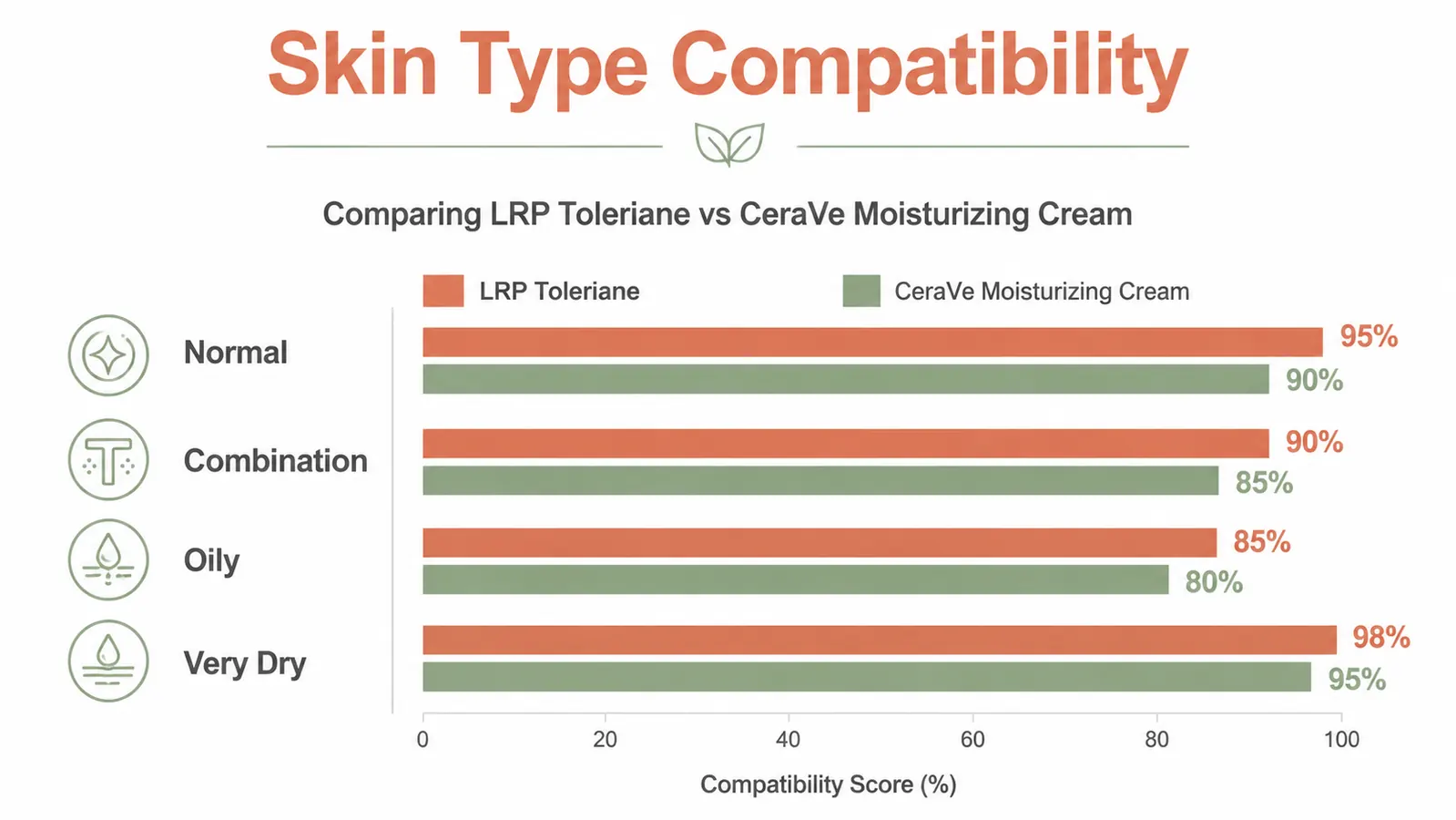
The Formula Overlap and Why It Still Matters
Both products share the same ceramide trio: ceramides 1, 3, and 6-II. These three work together to reinforce the lipid matrix that holds skin cells together, sealing in moisture and keeping environmental irritants out. The research on topical ceramides for barrier repair is solid, and both brands use meaningful concentrations rather than trace amounts added for marketing purposes. Both are also fragrance-free and include glycerin as a humectant to pull water into the outer layers of skin. That common ground is why these two get compared constantly. The differences come down to what each formula does beyond the shared ceramide foundation.
Toleriane builds on that foundation with thermal spring water and niacinamide, tuning the formula toward daily wear versatility and mild anti-inflammatory support. CeraVe Moisturizing Cream layers in more emollients and occlusives, tuning the formula toward maximum barrier protection and lipid replenishment. Neither formula is superior in an absolute sense. They are solving for different use cases, and understanding that distinction saves you money and frustration.

Skin Type Compatibility, Head to Head
Normal to combination skin: Toleriane wins easily. It hydrates without adding visible oil, does not clog pores on my T-zone, and keeps my cheeks comfortable through an eight-hour workday. I have tested this across four seasons in Brooklyn and it performs consistently regardless of humidity levels. CeraVe Cream tends to amplify shine on my T-zone by early afternoon, which makes it a poor choice for combination skin as a daily morning product.
Oily skin: Toleriane is the safer pick, though neither of these is a gel moisturizer designed specifically for oily skin. Toleriane at least absorbs quickly and does not leave the skin looking coated. CeraVe Cream on oily skin is generally a mismatch and will likely feel suffocating by midday. If your skin is oily, Toleriane may still feel richer than you want. A gel-cream or water-gel moisturizer is worth considering as a separate category.
Dry to very dry skin: This is where CeraVe Cream earns its reputation. If your skin is prone to flaking, feels tight after cleansing, or becomes reactive in low-humidity environments, the occlusive quality of the CeraVe jar formula will do more for you overnight than Toleriane can. That said, even for dry skin, Toleriane is worth considering as a daytime option while CeraVe Cream takes the nighttime slot. The two-product approach is not redundant. It is smart layering.
Sensitive and reactive skin: Both are fragrance-free and test well with reactive skin. Toleriane has the thermal spring water fraction and some clients with rosacea find it calmer than CeraVe Cream on bad skin days. If your skin is sensitized specifically from overuse of actives like retinol or acids, CeraVe Moisturizing Cream is often the recommended barrier reset product, and that recommendation is fair. In those cases I tell clients to use CeraVe Cream at night until the skin settles, then transition to Toleriane as their daily routine moisture.
Who Should Buy Which
Buy La Roche-Posay Toleriane Double Repair if you have normal, combination, or sensitive skin. Buy it if you need a moisturizer that works both morning and night. Buy it if you layer actives or wear SPF every day and need something that does not create friction in your routine. Buy it if you want niacinamide in your routine without adding a dedicated serum step. Buy it if you prefer a pump dispenser for hygiene and portion control. This is the product I keep in my own bathroom year-round, and the one I reach for when clients ask me for a single reliable daily moisturizer. My long-term Toleriane review goes deeper into what the packaging does not tell you, including how it performs over three months of consistent use.
Buy CeraVe Moisturizing Cream if you have very dry or eczema-prone skin that needs a rich protective layer. Buy it if you live in a cold or low-humidity climate and need serious overnight barrier protection. Buy it if you are recovering from a skin procedure and your barrier is genuinely compromised. Buy it if you need to moisturize a large body surface area and price per ounce matters. It is a legitimately good product, just one doing a different job than most readers of this article need it to do. Do not write it off. It simply did not win for the majority skin type among the women this comparison is written for. And if you are curious about the broader case for ceramide moisturizers on sensitive skin, the full Toleriane honest review covers what makes that ingredient category worth the investment.
Ready to give Toleriane a real test in your own routine?
La Roche-Posay Toleriane Double Repair is consistently in stock on Amazon and is one of the few moisturizers I recommend across multiple skin types without heavy caveats. Nearly 49,000 reviews, 4.6 stars, fragrance-free, niacinamide included. If you are looking for a lightweight daily moisturizer that works in every layer of your routine, this is a low-risk starting point.
Amazon Check Today's Price on Amazon →