
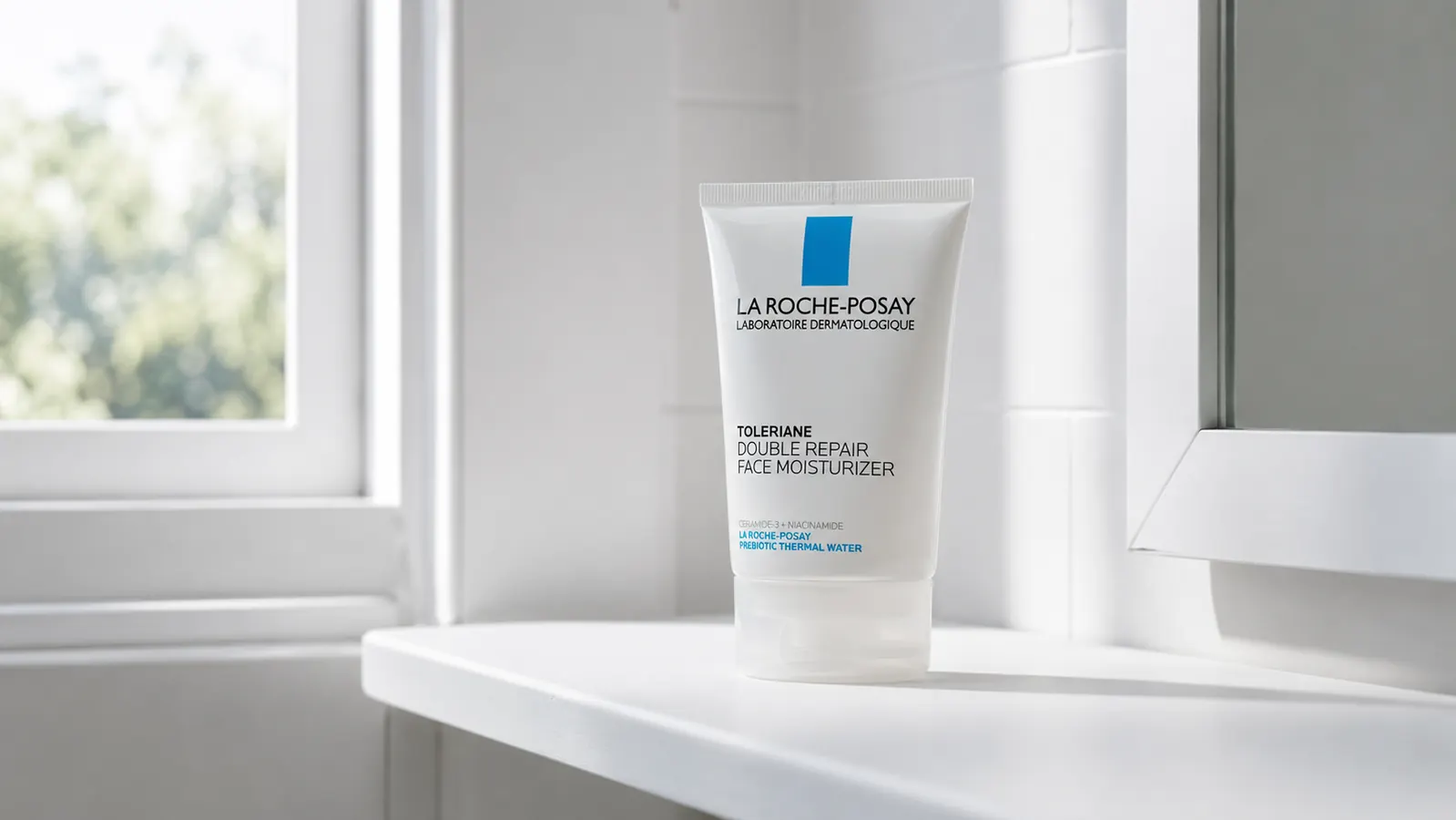
Let me tell you the thing that frustrates me about reading moisturizer reviews online. You find a product with 49,000 Amazon ratings and a 4.6-star average, and every review says the same thing: gentle, non-greasy, dermatologist-approved, great for sensitive skin. Nobody tells you that if your skin runs very dry, you are going to apply this at 7 a.m. and feel tight by noon. Nobody mentions that the pump has a personality of its own. And nobody bothers to question whether "double repair" actually means anything on the ingredient label.
I am Lena Park. I have been a licensed esthetician for nine years and I test products on my own face before I recommend them to anyone. I have been using La Roche-Posay Toleriane Double Repair Face Moisturizer in my practice and my own routine for over two years. I think it is a genuinely good product. I also think it is one of the most overprescribed moisturizers in the drugstore category, handed out as a one-size-fits-all recommendation for skin types that are going to be quietly disappointed by it. This review is for those people.
The Quick Verdict
An excellent everyday moisturizer for normal-to-combination and post-procedure skin. Genuinely good barrier support. Falls short for very dry skin types without a face oil layered on top, and the "double repair" branding sets expectations the formula cannot always meet on its own.
Amazon Check Today's Price →If your skin runs normal-to-combination and you keep reacting to other moisturizers, this is probably your answer.
La Roche-Posay Toleriane Double Repair has ceramides, niacinamide, and a fragrance-free formula at a drugstore price. Check whether it is currently in stock before you read the rest.
Amazon Check Today's Price on Amazon →What the Marketing Won't Tell You
"Double repair" sounds meaningful. In practice, it refers to two things the formula does: reinforces the skin barrier with ceramides and restores skin's natural microbiome with prebiotic thermal water (La Roche-Posay's Eau Thermale, sourced from La Roche-Posay, France). Both of those things are real. The ceramides in this formula are actual ceramide NP, ceramide AP, and ceramide EOP, not just a vague "ceramide complex" without identity. That matters. Ceramides are lipids that form part of the skin's protective barrier, and when you use a surfactant-heavy cleanser or go through a round of retinol adjustment, those lipids get disrupted.
Here is what the marketing does not tell you: niacinamide is listed on the label and the brand mentions it in product copy, but it is not listed high enough in the ingredient order to be therapeutic at most skin concerns. Niacinamide at 2 to 5 percent concentration can genuinely reduce pore appearance and support barrier function. The Toleriane Double Repair is not a niacinamide treatment. The niacinamide is here for support, not starring-role results. If you are buying this because you want to fade dark spots or visibly shrink pores with niacinamide, you will need a separate serum. The moisturizer layer is doing a different job.
The Eau Thermale is real, too. La Roche-Posay's thermal spring water has been studied and shows antioxidant and soothing properties. But it is water. It occupies the first ingredient slot because most water-based formulas lead with water, and Eau Thermale is a more interesting version of that. It is a genuine differentiator, but it is not magic. It gives this formula a slight edge in soothing reactive skin over generic purified-water formulas. That is worth something. It is not worth treating it as a primary active ingredient.
Texture Reality Check
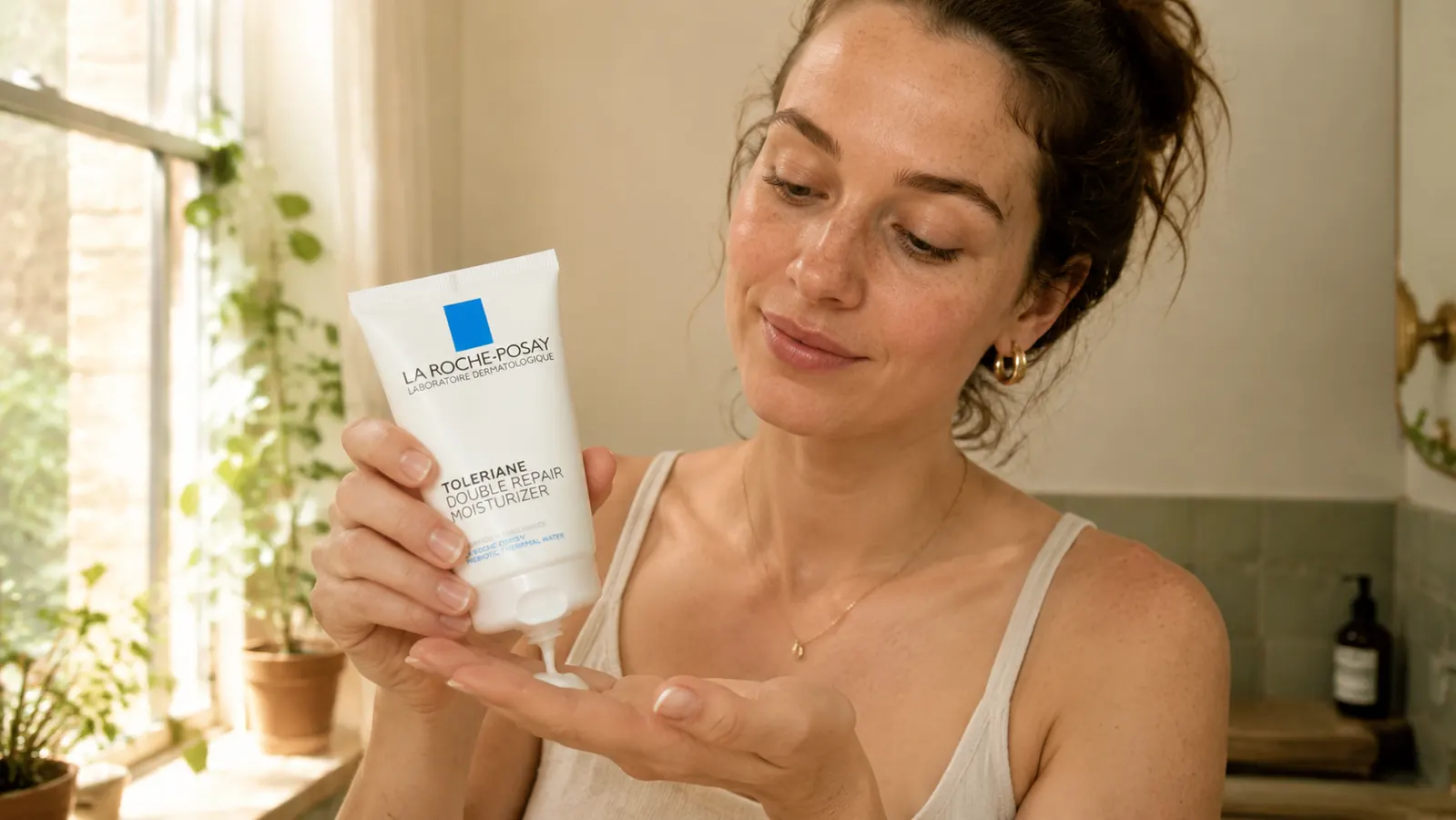
The formula is a lotion, not a cream. That distinction matters more than most people realize before they open the box. CeraVe Moisturizing Cream, which is frequently mentioned in the same breath as this product, is a true cream, thicker and richer, with more occlusivity. The Toleriane Double Repair spreads quickly, absorbs in about sixty seconds, and leaves a skin-like matte-to-dewy finish that feels invisible under makeup. It does not feel like putting anything on your face after the first minute. That is a specific kind of magic and a specific kind of limitation.
For normal, combination, or mildly dry skin, that texture is ideal. You can layer it under SPF without pilling. You can put it on before tinted moisturizer or mineral sunscreen without that thick-cake feeling. You can reapply over makeup in a small amount using a patting motion and it will not break down your base. This is legitimately useful.
For very dry skin, the texture is the problem. If your skin is flaking, pulling, or feeling tight within hours of application, a lotion is not going to cut it alone. The ceramides in this formula support barrier repair over time, but the immediate moisture load is not high enough to address acute dryness. I have seen clients with Fitzpatrick I-II dry skin layer this and still complain of tightness by mid-afternoon. The fix is straightforward: apply two or three drops of a squalane or rosehip oil before the moisturizer, or mix a drop directly into your palmful of Toleriane. The combination works well. But that is an additional step and an additional product, and you should know that going in rather than discovering it after a week of uncomfortable skin.
For normal-to-combination skin, the Toleriane Double Repair is nearly perfect. For very dry skin, it is a foundation that needs help, not a full solution.
The Pump Dispenser Quirks
The tube comes in two versions: a standard squeeze tube and a pump bottle. Most people buying on Amazon default to the pump, which is the more convenient-sounding option. Here is the reality of that pump. It dispenses a fairly large dose per press. For a normal or combination skin face, one pump is more product than you need for a full face application. You will spend the first week trying to palm off the excess onto your neck (which, honestly, is where you should be applying moisturizer anyway). Two pumps is the right amount for a face and neck application combined, but getting there takes adjustment.
The pump also tends to sputter slightly when the bottle is below half-full, dispensing air mixed with product before giving you a clean dose. It is not a deal-breaker. It is the kind of thing that makes you shake the bottle sideways and wonder briefly if it is defective, before realizing it is just the geometry of the pump tube getting longer than the remaining product depth. Squeeze tube versions of this formula avoid this entirely. If you find the pump annoying, switch.
The Niacinamide Concentration Question
I get asked about this constantly, so let me be direct. The Toleriane Double Repair contains niacinamide, and La Roche-Posay has listed it on the ingredient label and referenced it in marketing. The brand does not disclose the exact percentage. Based on the position of niacinamide in the ingredient list, relative to other listed ingredients, it is likely below 2 percent. That is not a condemnation. A sub-2-percent niacinamide concentration in a moisturizer can still contribute to barrier support. But if you are hoping to use this as a treatment moisturizer to meaningfully reduce hyperpigmentation or address post-acne marks, you should not rely on this product to do that work.
If niacinamide is a priority for your routine, pair this moisturizer with a dedicated niacinamide serum applied underneath. The Good Molecules 10% Niacinamide Toning Serum or Paula's Choice 10% Niacinamide Booster will give you a functional concentration. Then the Toleriane seals over the top of it. That layering approach is exactly what this moisturizer is built for: it sits on top of targeted treatments and does not interfere with them.
How It Compares to CeraVe and Cetaphil
These three names come up together constantly in the "gentle, fragrance-free, dermatologist-recommended" category, and the differences between them are worth understanding rather than treating them as interchangeable.
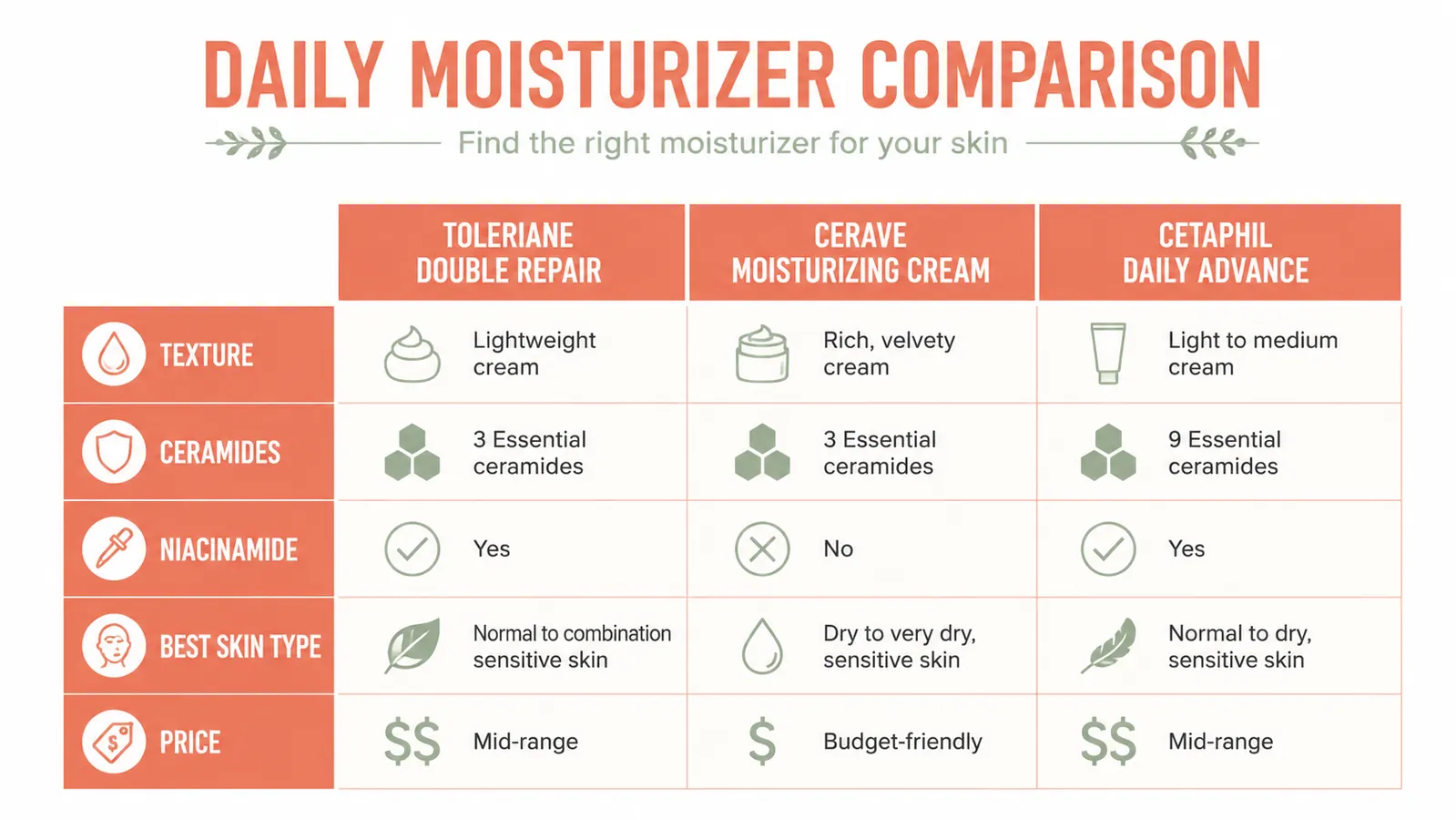
CeraVe Moisturizing Cream is richer and more occlusive than the Toleriane Double Repair. It contains three ceramides plus hyaluronic acid and MVE technology, which is a slow-release delivery system that extends hydration over time. For very dry skin, dry-to-normal, or skin in active barrier repair mode, CeraVe Moisturizing Cream is almost certainly the better choice. The tradeoff is texture under makeup: the cream version can pill under foundation if you do not wait long enough after application. The Toleriane Double Repair almost never pills.
Cetaphil Daily Advance Ultra Hydrating Lotion is a simpler formula, lighter on active barrier ingredients, and cheaper. It does not contain ceramides in the same form as the Toleriane or CeraVe. It is a solid moisturizer for normal skin that is not dealing with sensitivity or barrier damage. If your skin is relatively unfussy and you are just looking for a non-irritating daily lotion, Cetaphil works fine at a lower price point. If you are managing rosacea, eczema-prone skin, post-retinol adjustment, or any kind of sensitized barrier issue, the Toleriane Double Repair is meaningfully better.
The slight chemical-sunscreen perception that some reviewers describe is worth addressing. A small number of people with reactive skin report that the Toleriane Double Repair has a faint synthetic smell or a texture that feels vaguely like a sunscreen base. This is likely due to the thermal water emulsion base and the carbomer used to create the lotion's consistency. For the vast majority of users, there is no perceptible scent and no sunscreen feeling. If you are highly fragrance-sensitive, the fragrance-free formula should clear your threshold. But if you are among the small percentage who find that certain emulsion bases feel similar to sunscreen finishes, this is a reasonable thing to test on a small area before committing to a full bottle.

Better Alternatives if You Have Very Dry Skin
If your skin is persistently dry rather than occasionally dehydrated, I want to be honest with you: the Toleriane Double Repair was probably not designed primarily for you, even if every recommendation you read online suggests it. Here is what I would actually reach for.
CeraVe Moisturizing Cream is the closest ceramide-forward alternative that handles deeper dryness better. The thicker texture is the tradeoff, but for nighttime use or very dry skin types, the greater occlusion is worth it. You can use the Toleriane Double Repair during the day and the CeraVe Cream at night if you want both textures in your routine.
If budget is not a concern, First Aid Beauty Ultra Repair Cream is another well-formulated option for dry and sensitive skin with a more intensive moisture load. For very dry or eczema-prone skin, a dermatologist-prescribed moisturizer or Vanicream Moisturizing Skin Cream, which is free of virtually all common sensitizers, may serve you better.
If you love the Toleriane Double Repair but find it insufficient alone, the simplest upgrade is three drops of 100 percent squalane applied to damp skin before you press in the moisturizer. Biossance and The Ordinary both make affordable squalane. That two-step combination outperforms most heavier creams I have tried on moderately dry skin.
Who This Is For
Normal and combination skin types will likely love this moisturizer without reservation. It hydrates enough, absorbs fast, does not clog pores, and sits beautifully under everything from bare SPF to a full makeup base. If you have oily-combination skin that still needs hydration but hates the feeling of heavy moisturizers, this is one of the better daily options at this price point.
This is also excellent for anyone in barrier-repair mode: post-retinol adjustment, post-chemical peel, or recovering from a period of over-exfoliation. The ceramide profile is real and the formula is designed to support rather than stress a compromised barrier. Clients coming off prescription tretinoin often use this for the first few weeks of adjustment and report significantly less dryness and flaking compared to their previous moisturizers.
Rosacea-prone and reactive skin types also tend to do well with this. The Eau Thermale base has clinical evidence for soothing redness in reactive skin, and the complete absence of fragrance, essential oils, and harsh preservatives removes most of the common triggers. This is one of the moisturizers I recommend most often for clients whose skin flares unpredictably.
Who Should Skip It
Very dry skin types who need serious moisture, not just barrier support, will need something richer. If your skin looks tight in photos, peels in cold months, or feels uncomfortable within three hours of applying a standard lotion, this moisturizer is not your primary solution. Use it as part of a layered approach or switch to CeraVe Moisturizing Cream as your main moisturizer.
People looking for a therapeutic niacinamide treatment in moisturizer form will be disappointed. This product will not fade dark spots or make a visible difference in hyperpigmentation at the niacinamide dose it carries. It is a moisturizer first, a barrier support second, and a niacinamide delivery vehicle a distant third.
And if you are buying it primarily because 49,000 people gave it five stars, take a look at what skin types those reviewers have. The vast majority of glowing reviews come from people with normal, combination, or sensitized-but-not-very-dry skin. That is exactly the audience this formula was designed for. If that describes you, you will probably join the five-star chorus. If it does not, go in with eyes open.
What I Liked
- Fragrance-free, essential-oil-free formula tolerates extremely reactive skin
- Real ceramide blend (NP, AP, EOP) supports genuine barrier repair
- Invisible under makeup, SPF, and tinted moisturizer with no pilling
- Absorbs in under 90 seconds, no greasy residue
- Clinically tested on post-procedure and rosacea-prone skin
- La Roche-Posay Eau Thermale base has documented soothing properties
Where It Falls Short
- Not hydrating enough alone for very dry or flaky skin types
- Niacinamide concentration is likely sub-therapeutic for dark spot or pore concerns
- Pump dispenser over-dispenses and sputters when bottle is low
- Lotion weight means it does not provide sufficient occlusion for cold-weather or eczema-prone skin
- "Double repair" branding overstates what a single moisturizer layer can accomplish
Normal or combination skin that keeps reacting to other moisturizers? This is the one to try.
La Roche-Posay Toleriane Double Repair is legitimately well-formulated for reactive, sensitized, and combination skin. If your face flares from fragrance, essential oils, or heavier creams, this is a low-risk starting point with a real ceramide base. Check today's price and current stock on Amazon.
Amazon Check Today's Price on Amazon →