
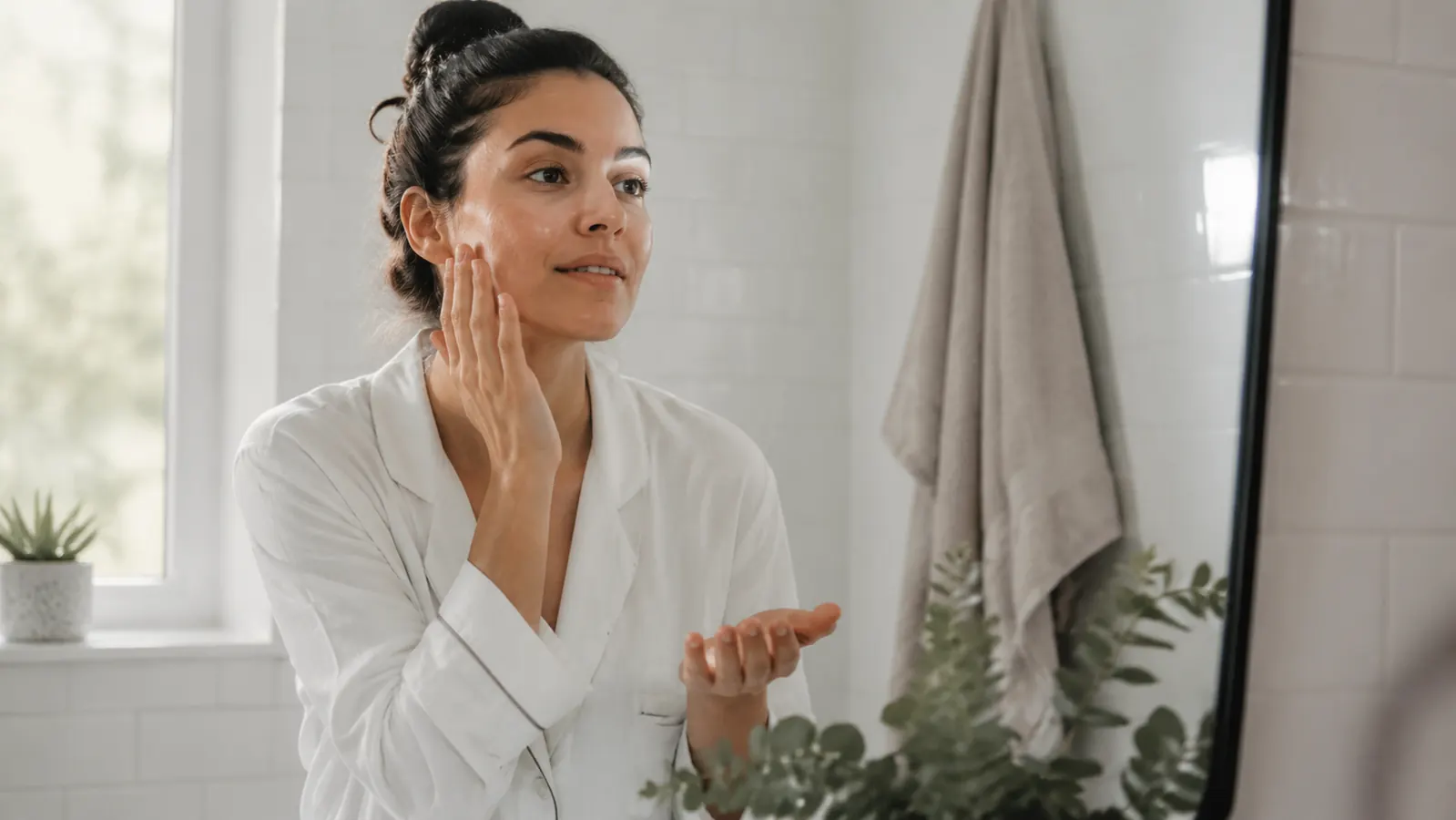
I have been a licensed esthetician for nine years and I can tell you without hesitation that sunscreen is the single most effective thing you can put on your face. I can also tell you that the number one reason people skip it is not laziness. It is a genuinely bad experience. You tried a sunscreen once, it looked grey on your skin or sat on top of your moisturizer like a waxy film, and you decided SPF was not for you. The problem was not sunscreen. It was that one sunscreen. The right formula, used the right way, disappears into your routine so naturally that you stop thinking about it. This guide covers every step, from picking your formula to resetting at night, plus the practical fix for every excuse I hear from clients.
My current daily SPF is the EltaMD UV Daily SPF 40, a zinc oxide formula with a moisturizing base that works under makeup and bare-skin days equally well. I will reference it throughout this guide, but the steps apply to any quality mineral or hybrid sunscreen you choose. The goal here is building a habit that sticks, not loyalty to one bottle.
If you have been putting off daily SPF because nothing has worked yet, this is the formula worth trying first.
EltaMD UV Daily SPF 40 uses zinc oxide with a moisturizing base that absorbs cleanly, leaves no white cast on most skin tones, and sits flat under foundation. Over 43,000 Amazon reviews and a 4.6-star rating back that up.
Amazon Check Today's Price on Amazon →The Four Excuses (and the Fix for Each)
Before we get into steps, I want to address the four complaints I hear most often, because if any of them have stopped you before, you need to know the solution before you try again.
Excuse one: 'It makes my skin greasy.' This is almost always a formula issue, not a sunscreen issue. Older chemical sunscreens and some European mineral formulas sit heavy. A modern zinc oxide formula with a lightweight emulsion base absorbs without residue. Look for 'oil-free' or 'matte-finish' in the description. If you run oily, a tinted formula with an absorbent finish tends to behave the best.
Excuse two: 'It leaves a white cast.' Zinc oxide is historically the culprit here because it is a white mineral. Current encapsulation technology has mostly solved this for light to medium skin tones. If you are deeper medium to dark, a tinted SPF is your best option because the tint compensates for the white mineral and leaves a skin-tone-accurate finish. Chemical filters (avobenzone, octinoxate) do not leave white cast at all, but they carry their own concerns for reactive skin types.
Excuse three: 'It breaks me out.' Sunscreens that break people out usually contain fragrance, heavy occlusive oils, or comedogenic emollients. Switch to a fragrance-free, non-comedogenic formula and give your skin three weeks to adjust. If you are still breaking out after three weeks, try a different base chemistry. Most people who think they cannot wear sunscreen have not found their formula yet.
Excuse four: 'I cannot reapply over makeup.' You cannot pump fresh sunscreen over a full face of foundation. But you can reapply with a mineral powder SPF, a sunscreen stick, or a setting spray with SPF. I cover exactly how in Step 5.
The Seven Steps to Daily SPF That Actually Sticks
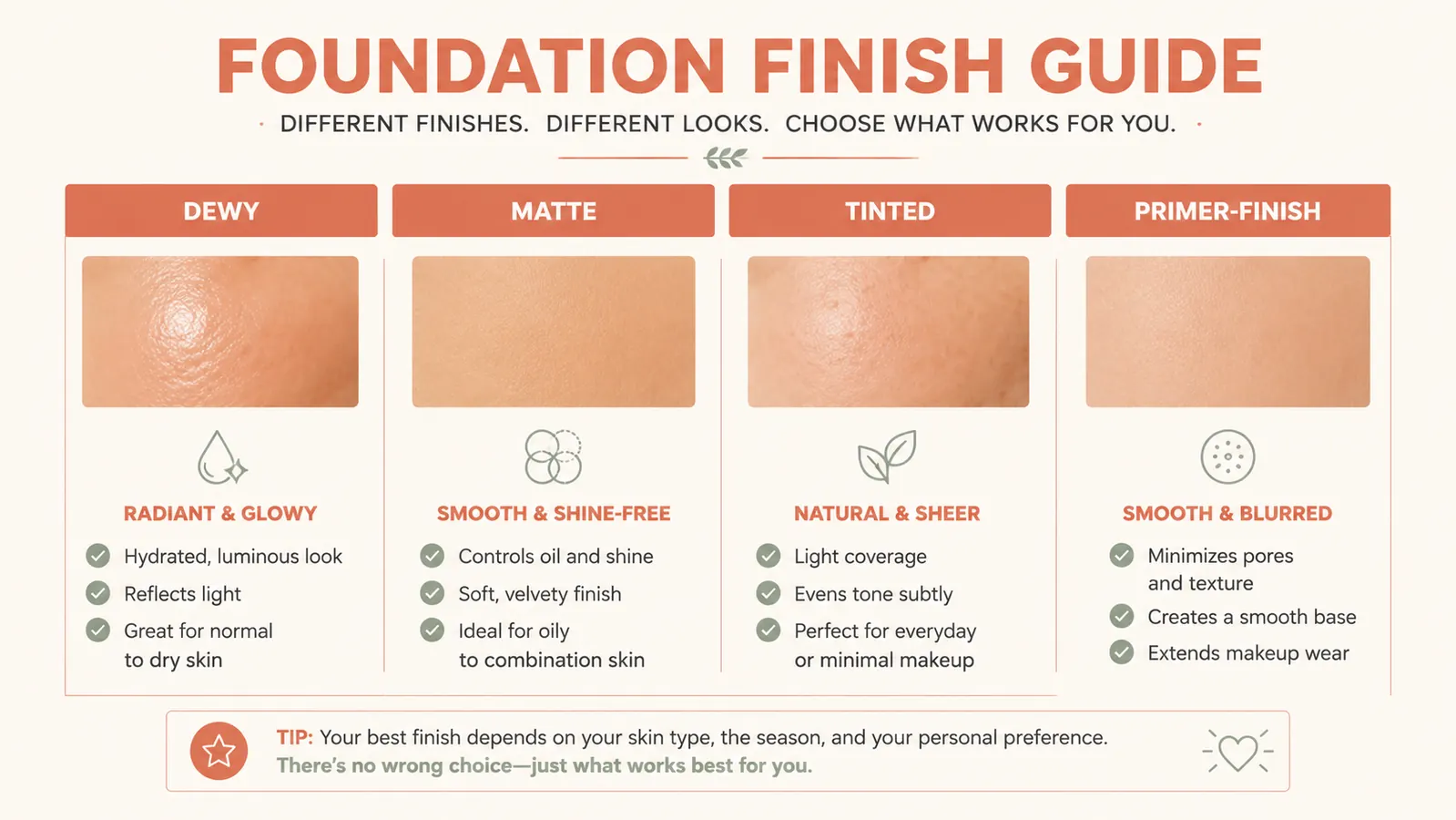
Step 1: Pick the Right Finish for Your Skin Type
Not every SPF formula is built for every face. Choosing the wrong finish is the fastest way to give up. If you run dry or normal, a dewy or moisturizing finish will feel comfortable and look healthy. If you run oily or combination, a matte or primer-finish SPF keeps shine down and your makeup in place longer. If you have uneven skin tone or want to skip foundation, a tinted SPF adds light coverage and corrects the white cast issue at the same time. EltaMD UV Daily SPF 40 falls in the moisturizing-but-not-dewy category: it absorbs cleanly without looking flat or chalky. It works best on normal, dry-combination, and sensitive skin types.
If you are shopping and not sure what finish a formula has, read the reviews for 'oily' and 'dry' mentions. That tends to give you the honest picture faster than the product description.
Step 2: Use a Teaspoon for Face and Neck, Not a Pea
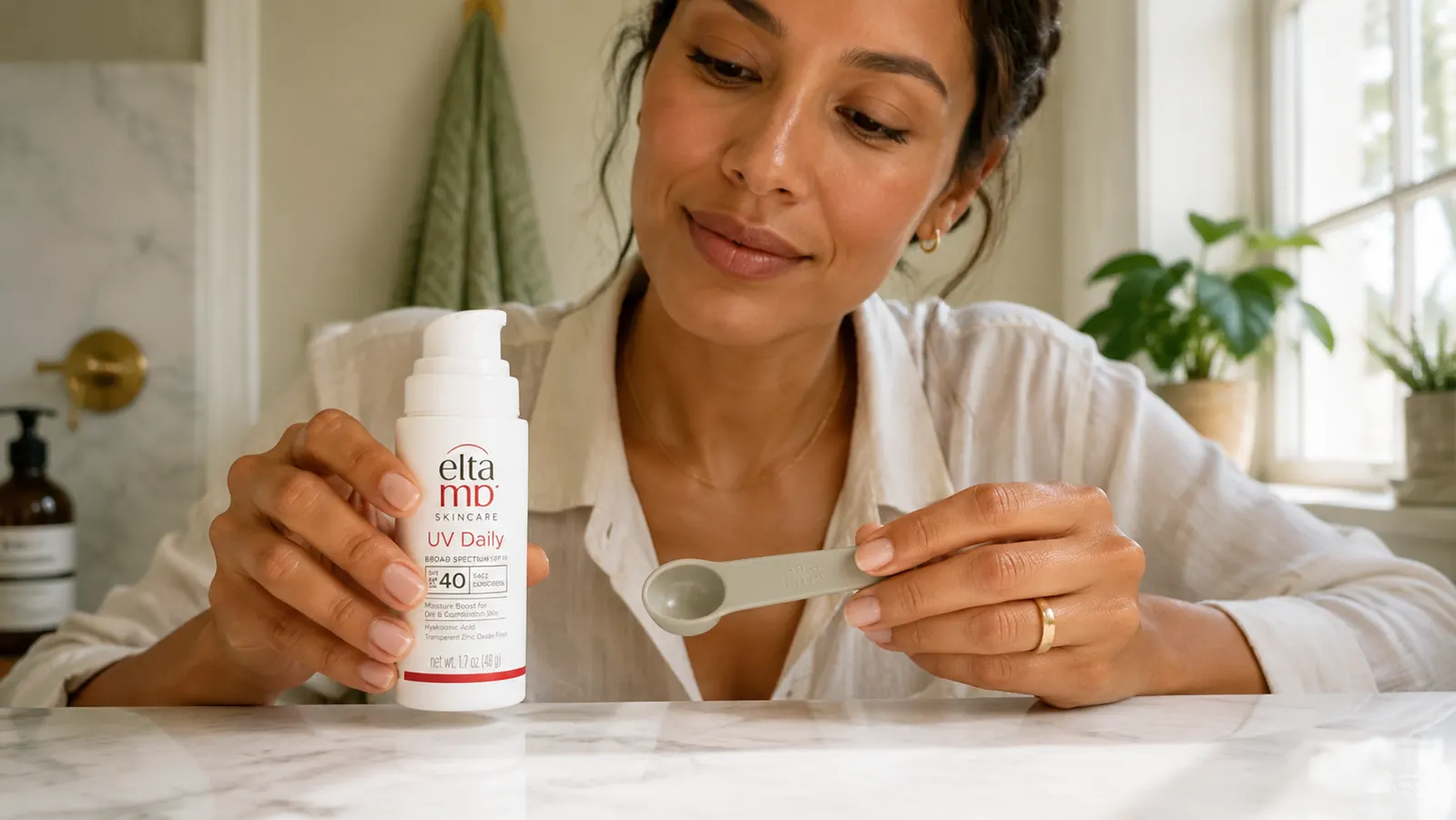
This is the most common error I see, even from people who wear sunscreen faithfully. The standard dosage used in SPF testing is 2 mg per square centimeter of skin, which works out to about one-quarter teaspoon for your face alone, or one full teaspoon if you include your neck and chest. Most people apply a pea-sized amount, which delivers roughly a third of the rated SPF protection. So if you are wearing SPF 40 but applying a pea, you are probably getting the equivalent of SPF 12 to 15 in practice.
I keep a small measuring spoon on my bathroom counter as a reminder. After a week or two you internalize what the right amount looks like and you stop needing it. The coverage should feel slightly visible on your skin for the first 60 seconds, then absorb to nothing. If it absorbs instantly without any temporary film, you probably under-applied.
Step 3: Apply After Moisturizer, Wait 5 Minutes Before Makeup
Sunscreen goes on after all other skincare products and before makeup. The order is: cleanser, toner or essence (if you use them), vitamin C serum or other treatment serums, moisturizer, then sunscreen. If you want to understand how the vitamin C layer fits, the guide on how to layer vitamin C serum in your morning routine covers that in detail.
The five-minute wait matters because SPF needs to form a uniform film to work. If you apply foundation directly on top of wet sunscreen you disrupt that film, and you also get pilling where the products have not had time to bind to the skin. Set a timer the first few times if it helps you build the habit. I use those five minutes to brush my teeth.
A note on pilling: if your sunscreen pills under foundation regardless of wait time, the cause is usually a silicone mismatch between your moisturizer and your SPF. Try removing your primer for a week and see if the problem disappears. EltaMD UV Daily SPF 40 is primer-optional because the zinc oxide base sits flat enough to go straight to foundation.
The rule I give every client: if you are only going to do one thing for your skin every single day, make it SPF. Retinol fades, serums run out, routines change. Sunscreen is the intervention that shows up in your skin ten years from now.
Step 4: Set with a Mineral Powder If You Run Shine-Prone
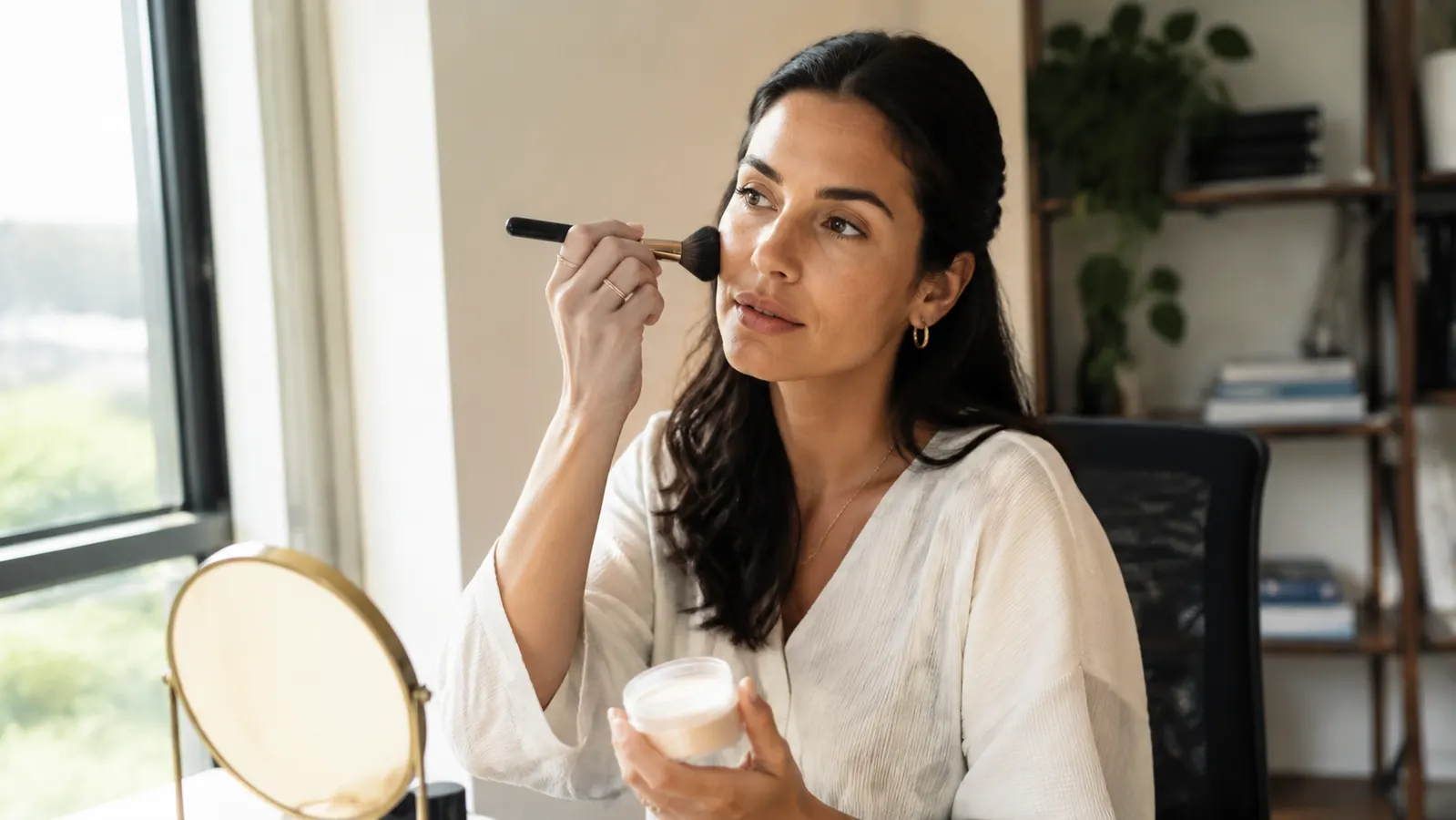
If you have oily skin and you are nervous about sunscreen making your face look like a glazed doughnut by 11 a.m., a mineral setting powder is your answer. A light dusting of a translucent mineral powder over your SPF absorbs excess sebum, locks the base in place, and gives you a clean matte start. Loose mineral powder works better than pressed here because it is lighter and less likely to clog pores.
This step is optional for normal and dry skin types. For combination to oily skin it is a genuine quality-of-life improvement that makes the whole SPF habit feel more sustainable. If you are skipping sunscreen because your skin looks greasy by midmorning anyway, give this a try for a week before you write off daily SPF for good.
Step 5: Reapply Midday Using a Stick, Spray, or Powder
SPF needs reapplication every two hours of sun exposure. For most people with an indoor job, this means once at lunch and once in mid-afternoon if you are spending any time near windows or outside. The challenge is that by midday you probably have makeup on and cannot pump fresh lotion onto your face. Here are your three practical options.
Option one is a sunscreen stick. These are solid, wax-based SPF formulas that you swipe directly over makeup. The wax does not lift or move makeup and is thick enough to provide real protection. Look for an SPF 30 or higher stick with zinc oxide or titanium dioxide. The tradeoff is they can look a bit shiny on oily skin.
Option two is a powder SPF. This is my favorite for most clients because it doubles as a touch-up and a reapplication in one step. Use a large fluffy brush, load it with powder, and buff across your face with the same coverage you would use to set makeup. Powder SPFs typically run SPF 30 to 50. The caveat: you need to apply enough powder to actually hit the dosage. A light dusting for blotting is not a sunscreen reapplication. Use a noticeable amount.
Option three is a setting spray with SPF. These work reasonably well in practice and are very fast to use, but independent testing has found that spray SPFs are hard to apply evenly enough to hit the labeled protection level. I use them as a better-than-nothing backup when I am in a hurry. The MyUVPatch, the wearable UV sensor that signals when your SPF protection has degraded, is a useful motivator during the habit-building phase. It does not replace an actual reapplication but removes the guesswork about timing.
Step 6: Full Cleanse at Night, The SPF Reset
Zinc oxide sunscreens do not rinse off with water. They sit on the surface of your skin and need an actual emulsifier to remove. If you are not double cleansing, or at minimum using a cleansing balm or oil-first cleanse before your foaming cleanser, you are going to bed with sunscreen residue on your face. Over time that contributes to congestion and dullness.
My standard night reset: oil cleanser or cleansing balm first (massage in for 60 seconds, then emulsify with water), followed by a gentle water-based cleanser. After that, your skin is genuinely clean and ready for your nighttime actives. This double-cleanse routine is especially important if you have been wearing a tinted SPF or SPF under foundation, because you have pigmented product as well as sunscreen to remove.
If you wear the EltaMD UV Daily SPF 40, any oil cleanser or cleansing balm removes it cleanly. I have tested it with the DHC Deep Cleansing Oil and the Banila Co Clean It Zero, both of which work well.
Step 7: Do Not Skip Eyes, Ears, or Neck
People tend to apply sunscreen in the center of their face and forget about the perimeter. The areas that get forgotten most often are the upper eyelid (below the brow), the outer orbital bone area near the temple, the ears (especially the top of the ear), the back of the neck, and the upper chest. These are also some of the areas where sun damage shows up fastest and most visibly.
For the eye area, EltaMD UV Daily SPF 40 is gentle enough for the orbital bone area for most people. I apply it about 1 cm from my lash line using my ring finger. If you have sensitive eyes, a dedicated mineral eye SPF is worth the extra step. For the back of the neck, use whatever is left on your hands after applying to your face and smooth it down the nape. Four extra seconds.
What Else Helps Build the Habit
The logistics of SPF are only half the battle. The other half is building a routine that makes applying sunscreen automatic rather than a deliberate choice. Keep your sunscreen on the bathroom counter where you cannot miss it, pair it with a habit you already have (apply SPF immediately after brushing your morning teeth), and track your streak for the first two weeks. Apps like Bearable or a simple paper habit tracker both work.
If cost is a friction point, a pump bottle of EltaMD UV Daily SPF 40 lasts most people about 10 to 12 weeks at the correct teaspoon dosage. That is roughly $0.38 per day. Compared to the cost of treating sun damage later, including hyperpigmentation treatments and dermatology visits, this is one of the highest-return line items in any skincare routine.
For more on why zinc oxide outperforms other filters for everyday use, the article on 10 reasons zinc oxide sunscreen belongs in every routine covers the mechanism. If you are building a new morning routine and want to see how this sunscreen performs layered over a vitamin C serum across six months of daily wear, the long-term review of EltaMD UV Daily SPF 40 has that detail.
You have the steps. The sunscreen that makes all seven of them easy is waiting on Amazon.
EltaMD UV Daily SPF 40 is fragrance-free, non-comedogenic, and formulated with zinc oxide for broad-spectrum protection. It absorbs cleanly, sits flat under makeup, and is gentle enough for daily use on sensitive and post-procedure skin. Over 43,500 reviews confirm it works for a wide range of skin types.
Amazon Check Today's Price on Amazon →