

I have been wearing sunscreen every single morning for the past six years. Occupational habit of a working esthetician. But if I am being straight with you, I used to dread it. Not because I doubted the SPF. Because most sunscreens I tested either left a grey tint on my NC30 skin, sat heavy under my makeup, or had me looking like I had been standing near a deep fryer by noon. Then I started testing EltaMD UV Daily Tinted Broad-Spectrum SPF 40 six months ago. I applied it every morning, Monday through Sunday, under makeup on workdays and alone on weekends. This is what actually happened.
Quick disclosure: this article contains affiliate links. If you buy through them, I earn a small commission at no added cost to you. I purchased my first two tubes myself and was sent a third by a rep at the six-week mark, but my opinion runs on my face, not on freebies.
The Quick Verdict
A genuinely lightweight zinc-hybrid sunscreen that layers under makeup without pilling, leaves no white cast on medium skin tones, and holds a satin finish through a full New York City day. The price is real, but for a daily-wear SPF that you will actually want to put on, it earns it.
Amazon Check Today's Price →If your current SPF is the reason you keep skipping sunscreen, this is what I switched to.
EltaMD UV Daily Tinted SPF 40 is available on Amazon with fast shipping. I go through roughly one tube every five weeks with daily full-face use.
Amazon Check Today's Price on Amazon →How I Used It
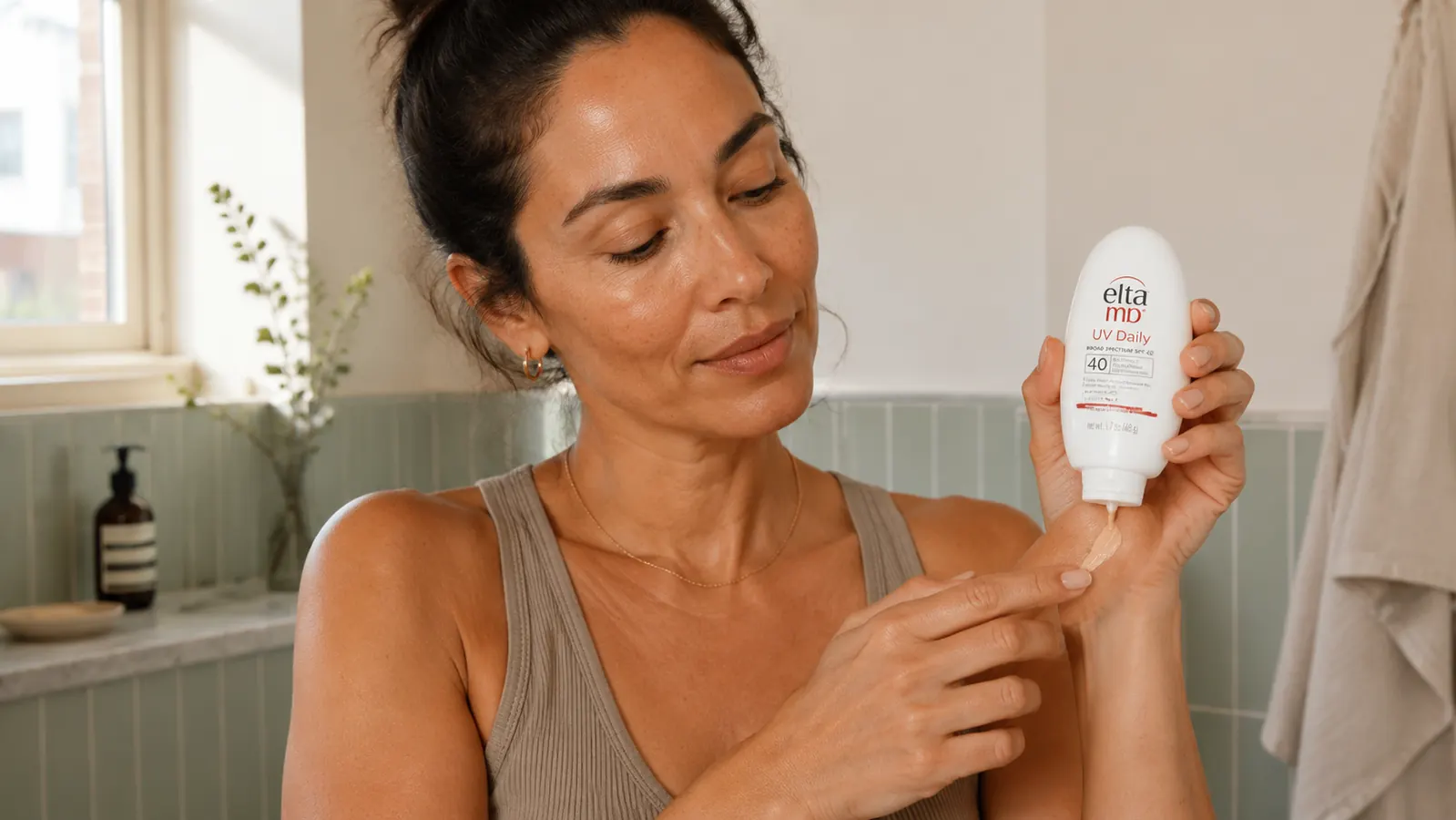
My morning routine runs: gentle cleanser, vitamin C serum, lightweight moisturizer, then sunscreen as the final step before any makeup. That is exactly where I slotted EltaMD UV Daily in. I used roughly two finger-lengths of product for my face and neck combined, which is consistent with the two-milligram-per-square-centimeter standard for adequate SPF protection. I applied it bare-handed, warmed it between my palms, then pressed and smoothed from center outward.
On weekdays I wore it under a tinted moisturizer and setting powder. On weekends I wore it alone. That split gave me a clear read on how the formula performs in two different contexts: as a base for other products and as a standalone finish. My skin type is combination, slightly oily in the T-zone, with mild sensitivity around my jaw. I logged notes at the two-week, four-week, and six-week marks, then kept wearing it through month six just to see if anything changed.
I also wore it around the eye area from the beginning. Estheticians spend a lot of time talking about eye-area sunscreen, because most clients stop at the orbital bone and leave the thinner skin near the eye completely unprotected. I wanted to see how EltaMD UV Daily behaved that close to the eye, including whether it migrated into the eye itself over the course of a day.
Texture and Feel
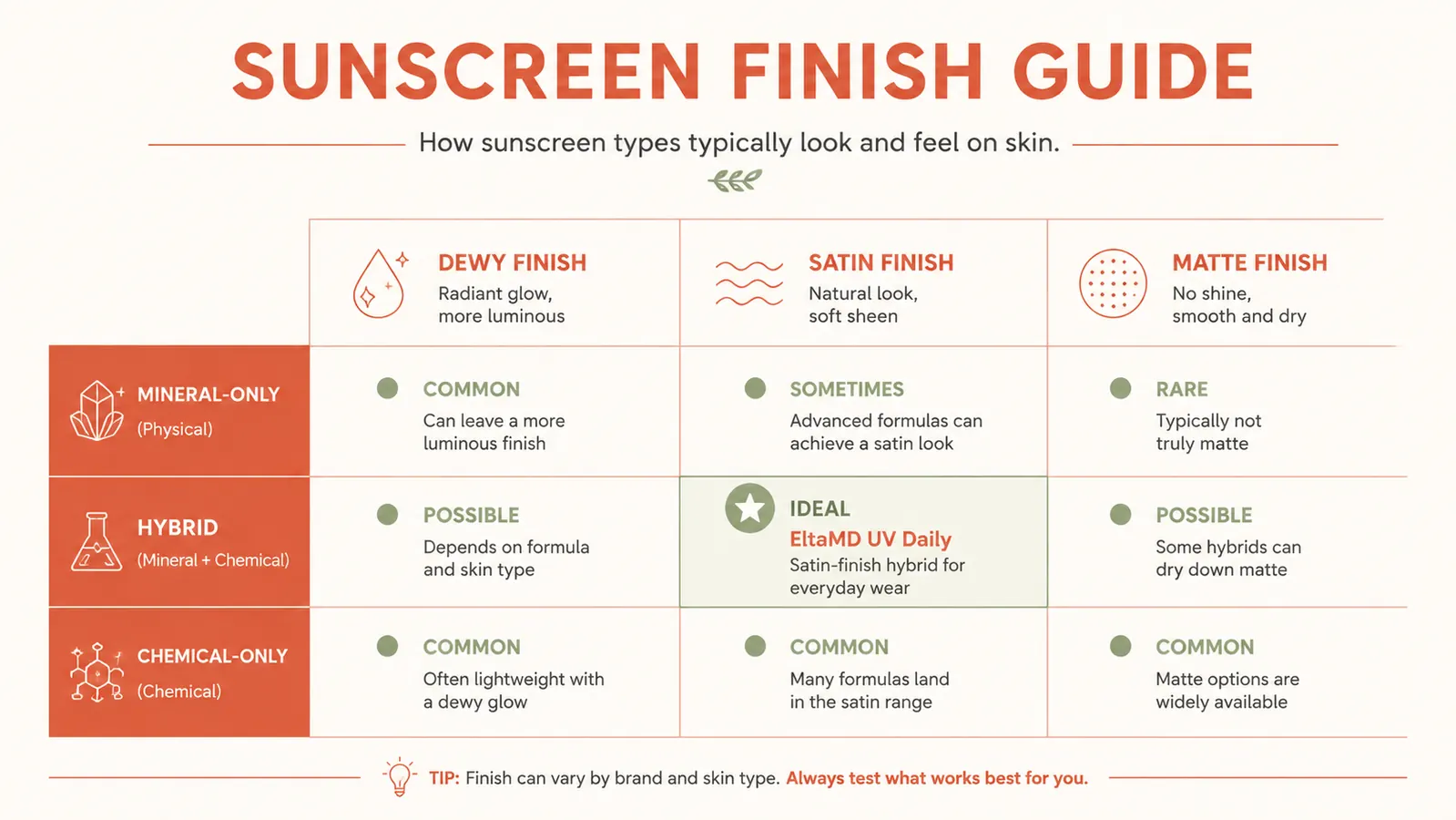
The first thing I noticed was the weight. Or rather, the lack of it. EltaMD UV Daily has a thin, slightly milky texture that reminds me more of a lightweight moisturizer than what most people picture when they think mineral sunscreen. It spreads fast. There is a brief moment of slip when you first apply it, then it sets into what I would call a satin finish: not dewy enough to look like you are wearing highlighter, not matte enough to feel powdery. Just skin. Good skin.
The formula uses a hybrid approach: 9% transparent zinc oxide for broad-spectrum mineral protection, plus octinoxate as a chemical UV filter. The zinc concentration is high enough to provide meaningful UVA coverage, but the transparency of the zinc particles and the supporting chemical filter mean the formula does not act like a traditional mineral sunscreen. There is no chalky aftereffect, no thickening as it dries. At the end of the day, my skin felt like skin. On warmer days in the city, I noticed some shine in my T-zone by mid-afternoon, which I address with a light powder. That is not a flaw in the product. That is just my skin being my skin.
There is a brief moment of slip when you first apply it, then it sets into a satin finish. Not dewy enough to look like highlighter, not matte enough to feel powdery. Just skin. Good skin.
The No White Cast Question
This is the question I get most from clients with medium or deeper skin tones when they ask about mineral sunscreens. White cast is a real problem with traditional zinc formulas because the zinc particles scatter visible light, and on deeper skin that scattering reads as grey or ashy. I have seen it happen on my own clients. It is one of the main reasons many women with medium-to-deep skin stick to chemical sunscreens despite the formulation tradeoffs.
EltaMD UV Daily handles this differently from most zinc-containing options I have tested. The tinted version uses a micronized, transparent zinc oxide, which means the particles are small enough that they do not scatter visible light the same way coarser zinc does. On my NC30 skin, I get zero white cast. Zero. Not a subtle greyness, not a temporary white film that fades after five minutes. It absorbs cleanly. I had a client with NC40 skin test the same formula during a facial appointment, and her experience matched mine: no cast, satin finish, worn comfortably under her regular foundation.
I want to be careful here: I have not tested this on NC50 or deeper complexions, and I am not going to tell you it photographs well on all skin tones without that data. What I can say is that for medium skin tones, the tinted version of UV Daily is the most cast-free zinc-containing sunscreen I have used in six years. If you are on the deeper end of the spectrum and want more certainty before spending current price on it, check community reviews from women who share your skin tone before committing.
Under Makeup Test
This is where a lot of sunscreens die. Pilling is the enemy. Pilling happens when the sunscreen has not fully set before you apply the next product, or when the product layers are simply not chemically compatible. I have thrown out expensive SPFs because they turned my foundation into little grey flakes by the time I finished blending.
EltaMD UV Daily did not pill on me once across six months. My routine after sunscreen: one pump of tinted moisturizer blended in with a damp beauty sponge, then a light dusting of translucent setting powder. All three layers sat together without incident. What helped: I gave the UV Daily about sixty seconds to set after application before moving to the next step. Sixty seconds, not ten minutes. That small pause was enough for everything to behave.
The hyaluronic acid in the formula contributes something real here. It keeps the skin surface just hydrated enough that the subsequent layers blend smoothly without dragging. On days when I skipped moisturizer and went directly to UV Daily, my skin felt comfortable through the morning but got a little tight by early afternoon. The formula is moisturizing for a sunscreen, but it is not a replacement for a dedicated moisturizer if your skin runs dry. If you have normal to oily skin, you may find you can skip the moisturizer step underneath, but I would not assume it for dry skin.
Eye Area Tolerance
I applied UV Daily up to the orbital bone and used a small amount on my upper eyelids and the under-eye area every morning. By the six-week mark, I had experienced no stinging, no milia, and no migration into my eyes during the day. This matters a lot to me, because the skin around the eyes is thin and absorbs product easily. A formula that sits well there without causing irritation is worth calling out.
On three separate hot, humid days in late summer, I wore the sunscreen during a morning walk and noticed no burning or stinging when sweat moved down my forehead. That is a low bar, but it is one that plenty of SPFs fail. The hybrid formula, unlike a pure chemical sunscreen with a high concentration of chemical filters, stayed put and did not appear to migrate aggressively with sweat. For an urban daily-wear sunscreen, city conditions are the benchmark that matters.
One note: the formula is not rated for water resistance. EltaMD makes sport versions of their lineup for that. UV Daily is a daily moisturizing sunscreen, not a beach sunscreen. If you are swimming, hiking in summer heat for hours, or spending extended time in direct sun, this is not the product for that situation. Reapply more aggressively if you are going to be sweating heavily or near water.
What I Liked
- No white cast on medium skin tones with the tinted formula
- Layers cleanly under makeup without pilling in sixty seconds of set time
- Satin finish that reads like well-moisturized skin, not an obvious sunscreen
- Hyaluronic acid keeps the formula comfortable without feeling heavy
- Eye area tolerant: no stinging, no milia, comfortable through the day
- Hybrid zinc and chemical formula offers broad UVA and UVB coverage
- Sets quickly on combination skin without exaggerating shine
Where It Falls Short
- Current price puts it at the higher end for a daily-use sunscreen you go through fast
- Not water resistant: not appropriate for swimming, beach days, or heavy outdoor activity
- T-zone shine by mid-afternoon on combination and oily skin types
- Hyaluronic acid moisturizing claim does not fully replace a moisturizer for dry skin types
- Tint range is limited: check fit for very deep skin tones before purchasing

Who This Is For
EltaMD UV Daily is built for the person who wears sunscreen every single day of the year and wants it to disappear into their routine. If you put on makeup in the morning and need your SPF to cooperate, this is a strong choice. If you have combination or oily skin and want a satin finish that does not amplify shine, this works. If you have been burned by mineral sunscreens leaving a white film on your medium-toned skin, the tinted version of UV Daily solves that problem cleanly. If you are sensitive around the eyes and want a formula you can use close to the orbital bone without stinging, this is one of the better options I have tried.
It also works well for anyone who has a streamlined routine. The hyaluronic acid and moisturizing base mean you are getting some skin conditioning alongside your UV protection. It will not replace a dedicated treatment product, but it simplifies the SPF step without sacrificing protection. For my clients who resist sunscreen because it feels like one more heavy product, this is usually the one that converts them.
Who Should Skip It
If you have very dry skin and need significant occlusive moisturization, you will likely find UV Daily insufficient on its own. The formula is more comfortable than most sunscreens, but it is not a rich moisturizer. Dry skin types will want to run a dedicated moisturizer underneath and use UV Daily purely as the SPF layer.
If you plan to spend time at the beach, the pool, or in any sustained outdoor athletic context, skip this formula and choose one of EltaMD's sport versions, which carry water-resistance ratings. UV Daily is a commuter and office formula. It holds up for city walking and sweaty subway commutes reasonably well, but it is not engineered for the demands of extended sun exposure. And if the current price feels like a stretch for a product you go through every five weeks, I understand that math. The honest comparison: this is cheaper than many European pharmacy SPFs and less expensive than some cult-status American chemical sunscreens. Whether it is the right call for your budget is a real question worth asking.
Bottom Line
Six months in, EltaMD UV Daily SPF 40 is still in my morning routine. That is the most honest endorsement I can give. I have tested and discarded a lot of sunscreens over the years, including some that cost more and some that came with impressive ingredient lists. UV Daily earns its spot because it solves the practical problems that actually keep people from wearing sunscreen every day: it is lightweight, it does not cast, it layers, and it does not make your face look like a science experiment by noon. Those are not small things. SPF you actually wear beats a theoretically better SPF you skip.
If you want to read more about how sunscreen fits into a full morning routine, I have a piece on how to wear sunscreen every day without hating it that covers layering order, reapplication strategies, and what to do if your current SPF pills. And if you are curious about the case for zinc oxide specifically, the article on why zinc oxide sunscreen belongs in every routine covers the formulation science in more detail.
Six months of daily testing later, this is still my SPF, and the one I recommend to clients who are ready to actually commit.
EltaMD UV Daily Tinted Broad-Spectrum SPF 40 is available on Amazon. One tube lasts approximately five weeks with consistent full-face use.
Amazon Check Today's Price on Amazon →